by Lorraine Luo
Chinese is the most spoken language around the world which has more than 1.1 billion users.[i] What needs to be clarified is that, the ways to categorize dialects in Chinese is debatable since some think Mandarin is a dialect of Chinese while some argue that Mandarin equals to Chinese. I think both opinions make sense but here we adapt the former view. Though it is not disputable that Mandarin is the standard form of Chinese, it is not the only dialect of Chinese since in Chinese people’s daily conversations they prefer to use their regional dialects rather than standard Mandarin.

The most commonly used dialects in Mainland China are Wu, Min, Xiang, Yue, etc. All these groups have their own sub-dialects.[ii] For example, Xiang dialect is a southern group of Chinese dialect which is mostly used in Hunan province. Under the Xiang group there are some sub-dialects such as Changsha dialect, Xiangtan dialect which are spoken in different cities Changsha and Xiangtan. The difference is only the geographical regions and it is common that people from the same regions speak same dialects.
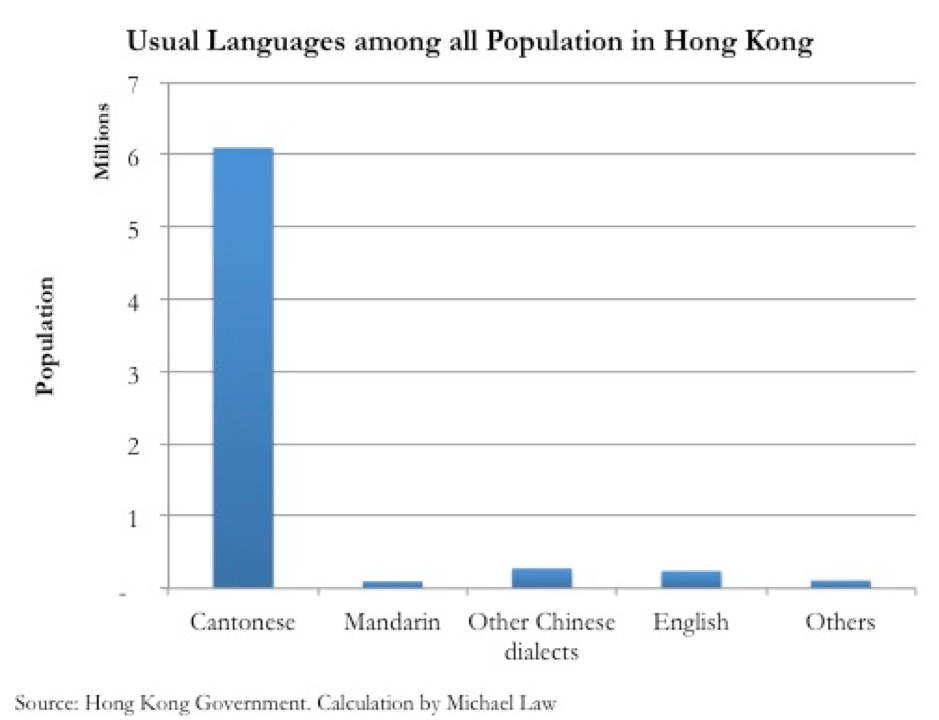
As for in Hong Kong, the categories of Chinese dialects are less than in Mainland. The most spoken dialect of Chinese in Hong Kong would be Cantonese which is originated from Guangdong province and adapted into Hong Kong by the earliest immigrants from Mainland. However, even though Hong Kong is part of China, considering its special political situations and colonized histories, its official language is not Chinese but English. So, the use of dialect Cantonese indexes speakers’ identities differently from in Mainland.
In Mainland China, the use of regional dialects can indicate speakers’ social identities of different habitation to differentiate from others (sometimes a sense of priority especially when you are a native dialect speaker in the originated place while others are not). This sense of priority also occurs in the use of dialect Cantonese in Hong Kong when non-Cantonese speakers meet native Hong Kongers. From my personal experience, when you chat with a native Cantonese speaker in Mandarin or English which indicates that you are not a Hong Konger, some natives will discriminate and alienate you.
As we can see, in Mainland the use of different dialects indexes social and cultural difference only to represent a sense of regional solidarity without political implications while in Hong Kong it indexes political identities and may lead to more obvious gaps between speakers because the dialect you speak indicates your political stances and political issues are sensitive in Hong Kong.
Furthermore, with the development of standard Mandarin and its popularization, the dialect use in Mainland China is declining and under this situation, the use of dialects sometimes indicates lower social position and being less educated and this also indexes less formal conversation contexts. However, in Hong Kong, things are different. Same popularization of Mandarin exists in Hong Kong, but the use of dialect Cantonese does not index lower social status or less education. On contrast, it indicates nativity and “purity” since some Hong Kongers reject everything related to the Mainland (according to an online blog survey).[iii
To conclude, even subordinate to the same language, the different dialect use in different areas performs different social identity formation. Some only indexes social and cultural identities while some involves political stances which may lead to interactional gaps at different levels. Also, a common phenomenon is that with the popularization of standard Mandarin, the use of dialects is declining, and inheritance of dialects is in danger. This should arouse people’s awareness of protecting dialects since dialects play a vital role in cultural heritage and historical treasure.
[i] https://www.fluentin3months.com/most-spoken-languages/
[ii] Dialects in China: http://www.mtholyoke.edu/~yu25s/classweb/worldpolitics/Site/Dialects_in_China.html
[iii] Online blog survey: https://www.quora.com/Why-do-Hongkongers-refuse-to-use-Mandarin-and-prefer-speaking-English-and-Cantonese

 Language Culture and Society in Hong Kong (and beyond)
The author compared the function of language in HK and mainland China detailedly. Also, the author mentioned politics, pointing out the dialects in China isn’t related to politics but a sense of regional solidarity so that I think the analysis is deep👍
LikeLike