Lost in Translation

by Sneha Lalwani

Once you roam the streets of Mong Kok or pass by any local “Dai Pai Dong”, you’ll see oddly put together sentences in English that make sense…. But also don’t.

The English side of the menu has weird translations. Translations like: “Stir-Fried Wikipedia, Steam Eggs with Wikipedia, Stir-Fried Wikipedia with Pimientos, etc…”

Now, we all know Wikipedia is inedible, right?

(“Jimmy Wales Grows Them Good and Organic“, 10/10/2007)

But it’s not only the restaurant menus here that have a random cluster of words stuck together to resemble something of a sentence, no. Some signs, notices and advertisements also have the same problem. 

No matter how crazy funny these translations may be, they simply could be errors. Spelling errors, grammar errors and a lack of understanding in English.

Or just Google Translate not being able to translate ‘Street Speak Cantonese’ into coherent sentences.

The problem is, with certain restaurants, they may not feel the need to hire professional translators everytime they change the menus. And ‘notice-makers’ may believe the general audience is Chinese so they will understand the sign without having to read the English translation.

You see, the reason is that even fluent translators may find the task of translation difficult, and food menus are especially challenging. Certain phrases, words and meanings get lost in translation. 

We’ve all tried to tell a joke and translated it, but it just didn’t sound as funny in the other language! This is a common occurrence in translation. Meanings often get left behind.

These mistakes are more apparent with languages as different as English and Chinese. Chinese is an ideograph language, while English is an alphabet based language. 

Which would explain why certain dishes like “毛血旺” would be translated literally into “Wool Blood Flourishing” instead of “duck blood and beef tripe soup”

and signs like “汀步路,小心滑倒!” would be translated into “Slip and fall down carefully!” instead of “Downwards slope, Caution-Slippery!”

(35 Hilarious Chinese Translation Fails, Lina D, Bored Panda, 2013)

Chinese sentence structures are vastly different from English sentence structures. So much so, that if you translate word for word, you get weird sentences. These badly translated words can be rephrased and arranged grammatically only if the context is known.

The main problems in translation are:

  1. The Grammar

In Chinese there is no singular or plural form. It also doesn’t have verb conjugations to indicate tenses. It means you should figure the translation out only by getting the context.

  1. Idioms and Proverbs

There are a number of indirect expressions in Chinese. We all know tradition and culture is deep rooted in Chinese, and when it comes to translating idioms, you may need to read the idiom over and over again. It may seem incomprehensible at first and difficulties may arise when describing things too.

  1. Sentence Structure and Construction

In Chinese, the two types of sentences are simple and complex sentences. 

The complex sentence is made up of a big combination of simple ones. Therefore it is quite important for a translator to have good command of sentence patterns.

(It’s never your successful friends posting the inspirational quotes, Facebook, 29/03/19)

In this photo, the Chinese ‘proverb’ “遠睇如絲如畫近睇係猪扒” is translated as “you talk like angel walk like model but your body look like buffalo.”

But if you translate the phrase without translating the unnecessary parts, the translation would be “You look better from a distance, Ugly up close.”

Now the thing here is that in Chinese, the phrase rhymes, but in English, creativity and knowledge is needed to make the phrase rhyme.

We may think this is entertaining, but bad translations like this often hurt a country’s image. Posing a threat to a country’s multilingual status.

In some cases, the translations can get so horrible that they contain hurtful slurs or slang that may damage the city’s image more.

Public signs and English menus are a good way to ensure tourists come around, especially if they are done right. But of course, this job relies heavily on the translators. Literal translation, should not be the answer to things like this, as it may be classified as ‘Bad English’ 

To end this on a lighter note, some translations are perfectly fine! Just tragically mistyped, like the picture below.

(Irene Raun, Pinterest)

How the use of dialects in Chinese shapes identities differently in Hong Kong and in Mainland China.

by Lorraine Luo

Chinese is the most spoken language around the world which has more than 1.1 billion users.[i] What needs to be clarified is that, the ways to categorize dialects in Chinese is debatable since some think Mandarin is a dialect of Chinese while some argue that Mandarin equals to Chinese. I think both opinions make sense but here we adapt the former view. Though it is not disputable that Mandarin is the standard form of Chinese, it is not the only dialect of Chinese since in Chinese people’s daily conversations they prefer to use their regional dialects rather than standard Mandarin. 


Dialects in Mainland China https://en.wikipedia.org/wiki/Mandarin_Chinese

The most commonly used dialects in Mainland China are Wu, Min, Xiang, Yue, etc. All these groups have their own sub-dialects.[ii] For example, Xiang dialect is a southern group of Chinese dialect which is mostly used in Hunan province. Under the Xiang group there are some sub-dialects such as Changsha dialect, Xiangtan dialect which are spoken in different cities Changsha and Xiangtan. The difference is only the geographical regions and it is common that people from the same regions speak same dialects.


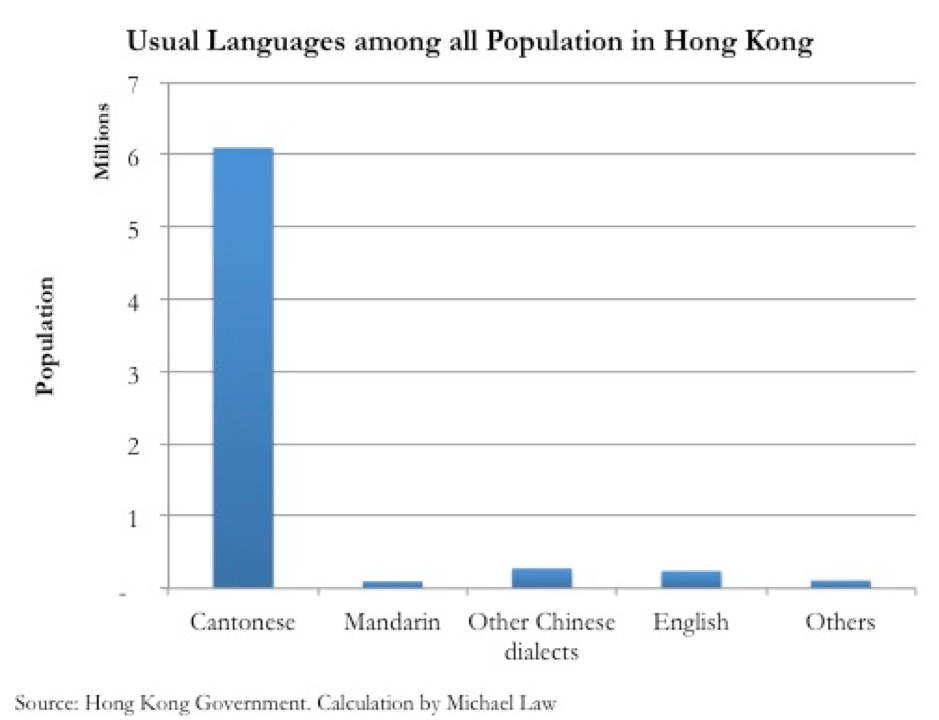
Languages used in Hong Kong https://blogs.harvard.edu/michaellaw/2014/02/19/cantonese-in-hong-kong-not-the-official-language/

As for in Hong Kong, the categories of Chinese dialects are less than in Mainland. The most spoken dialect of Chinese in Hong Kong would be Cantonese which is originated from Guangdong province and adapted into Hong Kong by the earliest immigrants from Mainland. However, even though Hong Kong is part of China, considering its special political situations and colonized histories, its official language is not Chinese but English. So, the use of dialect Cantonese indexes speakers’ identities differently from in Mainland.

In Mainland China, the use of regional dialects can indicate speakers’ social identities of different habitation to differentiate from others (sometimes a sense of priority especially when you are a native dialect speaker in the originated place while others are not). This sense of priority also occurs in the use of dialect Cantonese in Hong Kong when non-Cantonese speakers meet native Hong Kongers. From my personal experience, when you chat with a native Cantonese speaker in Mandarin or English which indicates that you are not a Hong Konger, some natives will discriminate and alienate you.

As we can see, in Mainland the use of different dialects indexes social and cultural difference only to represent a sense of regional solidarity without political implications while in Hong Kong it indexes political identities and may lead to more obvious gaps between speakers because the dialect you speak indicates your political stances and political issues are sensitive in Hong Kong.

Furthermore, with the development of standard Mandarin and its popularization, the dialect use in Mainland China is declining and under this situation, the use of dialects sometimes indicates lower social position and being less educated and this also indexes less formal conversation contexts. However, in Hong Kong, things are different. Same popularization of Mandarin exists in Hong Kong, but the use of dialect Cantonese does not index lower social status or less education. On contrast, it indicates nativity and “purity” since some Hong Kongers reject everything related to the Mainland (according to an online blog survey).[iii

To conclude, even subordinate to the same language, the different dialect use in different areas performs different social identity formation. Some only indexes social and cultural identities while some involves political stances which may lead to interactional gaps at different levels. Also, a common phenomenon is that with the popularization of standard Mandarin, the use of dialects is declining, and inheritance of dialects is in danger. This should arouse people’s awareness of protecting dialects since dialects play a vital role in cultural heritage and historical treasure.

[i] https://www.fluentin3months.com/most-spoken-languages/

[ii] Dialects in China: http://www.mtholyoke.edu/~yu25s/classweb/worldpolitics/Site/Dialects_in_China.html

[iii] Online blog survey: https://www.quora.com/Why-do-Hongkongers-refuse-to-use-Mandarin-and-prefer-speaking-English-and-Cantonese

Tam Jai accent: The Representative of Mandarin Accent Cantonese

by Alice Ng

Do you know what is “TamJai accent”?  If you are a good Cantonese speaker and have visited TamJai, you must understand what that is.  But if you don’t, this article will answer the question.

“Tam Jai”, one of Hong Kong’s most popular restaurant chains, serves Yunnanese rice noodles with a wide range of options from base to condiments to spiciness level.  It grasped popularity and expanded to more than 100 stores in recent years.  Interestingly, most of the waiters and waitresses of the restaurant are new migrants from mainland China, as a result, their workers usually speak Cantonese with a Mandarin accent and it is considered as the “Tam Jai accent”. The accent often makes changes in meaning and is seen as a joke, for example, mak yun(墨丸) which mean cuttlefish ball, become mat yin(勿演) meaning don’t act; juk sing(竹笙) meaning bamboo fungus originally, become chuk sing(畜牲)and give a new meaning: beast.  

Tam Jai Restaurant

Although it started to be a discriminatory joke which made fun of the distortion of meaning, it turned out to be a popular characteristic of the store and gained its popularity.  It is popular for Hong Kong youtuber to take video clips to imitate the accent and share their experience in the shop.  The accent was not only filmed in soap opera and tv commercial, but also characterized into an animation character in the Chinese version of a Japanese game Food Fantasy(食之契约 / フードファンタジー) as Hong Kong feature food.  

Local actor using TamJai accent in the TV commercial
The sound actress performing TamJai accent

However, some voices argue that the accent is inappropriate and would affect the use of proper Cantonese.  When the abovementioned game released, many local players argue the appropriacy of using such accent to represent Hong Kong.  Hong Kong people generally hold negative attitude towards Mandarin and Mandarin accent.  There are views that new immigrants, often associated with Mandarin accent, strain Hong Kong’s resources in welfare, education, and land level without much contribution to the society and economy or even attempting to adapt to the local community.  It is common for people to think that mainland immigrants are under-educated and not culturally civilized.  The stereotyping affects mainland accent users in workplace, school and even community.  News media, especially those with a democratic stand, would even report negative news like frauds and injury cases with an emphasis of the accent of the suspect.  

It is often to hear that language reflect one’s identity.  In the case of Hong Kong, proper Cantonese represents the difference in family background.  As illustrated by a legislation council member, Ho Kai-ming, in the following video, Hong Kong is actually a city that full of immigrants.  He makes use of TamJai accent as an example of inaccuracy of Cantonese pronunciation to highlight the relationship between immigration policy and Cantonese.  The Cantonese used in Hong Kong nowadays is highly influenced by immigrants back in the 18thand 19th century.  As a result, the language used by the majority native Cantonese speakers in Hong Kong largely differ from Cantonese used in Guangdong province which is considered as the standardized version of Cantonese.  Furthermore, the concept of new immigrants did not emerge until the handover to China in 1997, and hence, I can say that the standard language in Hong Kong is actually a “Hong Kong accent Cantonese” and whether you are able to speck in Cantonese without a heavy Mandarin accent do not necessarily reflect you are Cantonese-native or not, but how long you have moved into Hong Kong.

If you can speak both languages, you must understand that although Cantonese is regarded as a dialect by many Mandarin speakers, it greatly differs from Mandarin in terms of pronunciation, intonation, grammatical structure, romanization system and expression which make the two not mutually intelligible.  It is appreciativethat those workers at least try to use Cantonese to communicate with costumers and each others even though it is difficult to learn it and every locals in Hong Kong are supposed to know Mandarin.  It is important for us to understand that the accent isn’t a symbol of alienation, but a process of assimilation for them to culturally accommodate into the society.  To judge a person simply by how well he/she use a language is never a smart thing to do.  

See for reference

Hong Kong’s popular Tam Chai Yunnan Noodle to be bought by Japanese group

Hong Kong accents – The Characteristics of Hong Kong English

by Christy Chow

Cr. Language Contact

English is one of the official languages in Hong Kong, which is significantly used in the Government, business sector and educational sector. It is not uncommon to see the bilingual road and government signs along the street. Hong Kong had been a colony of Britain and was under British rule from 1841. Before the handover of Hong Kong From Britain to China, Hong Kong had been immersing in an English environment in which using English for communication became gradually common. However, due to the influence of native Cantonese speaker, people in Hong Kong developed a unique accent when speaking English. 

According to the study of Swell (2012), there are a few consonantal features in Hong Kong English. In this blog, some of the major features will be explained briefly to introduce Hong Kong English. 

1) [n] / [l] conflation

The use of [l] in place of [n] is rather more common than the inverse, and it may be associated with the recent changes in Cantonese in which there is progressive use of traditional words that began with [n] to [l]. For example, in Hong Kong English, people may pronounce the word ‘l’eed instead of ‘n’eed, ‘l’ever instead of ‘n’ever. 

2) TH-

This is a very typical type of accent characteristic of Hong Kong English. It has been extensively observed that the voiceless TH is occasionally pronounced as [f] in Hong Kong English. Furthermore, this observation is observed under different situations such as the pronunciation of voiceless TH in initial, medial and final position. For instance, in initial position, very often Hong Kong people pronounce ‘think’ /θɪŋk/ as /fɪŋk/. Seemingly, for ‘thank’, people often pronounce it as /fæŋk/ instead of /θæŋk/. While for the medial position, it is also uncommon to see people pronounce ‘something’ (/ˈsʌm.θɪŋ/) as ‘someting’ (/ˈsʌm.tɪŋ /), in which the voiceless TH is pronounced as [t] sound. Lastly, in the final position, there are also words that we normally pronounced them wrongly. Take ‘youth’ as an example, we often mispronounce the -TH as [f] instead of [θ]. 

3) Final consonant cluster

There is a trend in Hong Kong in the simplification of final consonant clusters, specifically with the exclusion of final consonant. However, we should note that this is not only the characteristic of Hong Kong English but also a universal feature of spoken English. And in fact, Hong Kong English speakers actually omit the [t] in word phrase less often than speakers from other countries. For example, we can take a look at the words with a word-final plosive, [t], [d] or [k]. In word phrases such as ‘most of’, ‘friend and’ and ‘think it’s’, the [t], [d] and [k] in respective word phrase are deleted. One noticeable feature is that in the word phrase ‘kind of’, the [d] is omitted nearly in every case. 

4) Initial consonant cluster

People in Hong Kong often confused between the pronunciation of [l] and [r]. Indeed, when [r] is the second sound in a consonant cluster, in most instances the [r] would be pronounced as [l]. For example, the word crowded /ˈkraʊ.dɪd/ is often pronounced as /klaʊdId/, and please /pli:z/ as /pi:z/. While on the other hand, there is also a replacement or omission of [r] and [l] in some words. As in the word ‘applied’, people pronounce it as /əˈpaɪd/ instead of /əˈplaɪd/. Another example is that ‘primary’ is pronounced as /ˈpaɪ.mər.i/ instead of /ˈpraɪ.mər.i/.

5) L-vocalization or deletion

This is the most common characteristic of Hong Kong English. Most of the time, Hong Kong people pronounce the words such as ‘will’ from /wɪl/ to /wɪu/ and ‘oral’ from /ˈɔː.rəl/ to /ˈɔː.rəu/, that is a use of vowel which is an l-vocalization. Besides l-vocalization, there is also l-deletion rather than replacement after a back vowel. For instance, ‘call’ is pronounced as /kɔ/ instead of /kɔːl/ and ‘cool’ is pronounced as /ku/ instead of /kuːl/. Vocalization of [l] is actually really common like Singapore also has this kind of problem. 

To conclude, the characteristics of Hong Kong English accents are obvious. If you go to another country and speak English, people would probably think you are a Hongkonger! However, what we need to know is that there is always variation between things, so as languages. English can be spoken with a Hong Kong accent or it can be spoken professionally when you are in a formal situation. It depends on the context of history or culture. More importantly, Hong Kong accent makes us identify us as a Hongkonger!

References

Deterding, D., Wong, J., & Kirkpatrick, A. (2008). The pronunciation of Hong Kong English. English World-Wide, 29(2), 148-175.

Sewell, A. (2012). The Hong Kong English accent: Variation and acceptability. Hong Kong Journal of Applied Linguistics, 13(2), 1-21.

How social factors affects one to be multilingual in Hong Kong

by Junny Law

Being able to speak multi languages in Hong Kong seems to be a feature of high class, as people think they have more prestige. The ability of speaking in a wide variety of language is influenced by many factors. Where we live, which sex we belongs to and how old we are are the common reasons. In this article, it takes a deep look at these factors and how multilingualism affects one’s impression, the prestige.

(Wong Tai Sin in 1924, Chuk Yuen Village is where Wong Tai Sin Temple stands now. p. 347 of Historical cum Social Study on Kowloon City district in connection with Kai Tak area.)

Firstly, regions show that the use of languages varies across geographical places. With regards to Bacon-Shone, Bolton and Luke (2015), residents in the eastern part of the Hong Kong Island (eastern) can speak English, Cantonese and Putonghua well, while Wong Tai Sin (WTS) residents has the lowest ability. WTS people cannot speak as great and many types as the eastern part since the accessibility of WTS is lower. Many decades ago, it was a slope with many rivers, which was inconvenient to have interactions. Even until now, there remains hills and slopes in that area, like the Diamond Hill, which separates residents to have much connections. Meanwhile, Hong Kong island provides more opportunities to speak these languages even though there are also many slopes. Since Hong Kong Island is a known commercial center, the core for business development, places around Central are the nice accommodations for international elites. With the global perspectives and the diversified culture, eastern residents have better understandings on different languages and even can socialize in multi languages. Therefore, districts affect us to be multilinguals.

Secondly, gender brings effect on being a multilingual. According to the Census and Statistics Department in 2019, men have higher ability to speak different languages totally. Take English and Putonghua speaking as the examples, the differences between the abilities of male and females are the lowest, 1.7%, and the highest, 3.6%, respectively. Shocked by the result, more men can speak Mandarin well, even though the reality gives impressions that many mainland women come and live here and women gossip lots. They seem to know more languages or dialects. However, the fact shows an opposition. Men are better to languages since they are required to talk more formally. For instance, it is a phenomenon that there are more men to say rules in the occupational situations, so they usually interact with others in a more official and formal way. They need to have their speech more carefully. Unlike women, who mainly speak languages to show opinions. Thus, sex is a factor of being multilingual.

Thirdly, the use of languages is affected by ages. Teenagers are more familiar with different languages than the elderly. As stated by Bacon-Shone et al. (2015), there are nearly 60% of the adolescents can speak Cantonese, Putonghua and English while it reaches to lower than 10% at elderly in 2011. There is a continuously decline of the percentage, which means that the younger the citizens are, the higher rate they are the multilinguals. As during 15-19 years old, teens receive education or work in societies, where they receive the up-to-date information and can follow the trends to upgrade themselves, they use and speak more languages. However, the elderly, who may feel satisfied with their life, are not willing to receive further education. Besides, their body functions are poorer that it is difficult to have mouth movements and memorize the languages that once they are used to speak. They do not speak as frequently as the youngers. Thus, whether we can be the multilinguals dependents on our ages.

(See the green line.)

Last but not least, being a multilingual can add marks on the first impression. As speaking more languages can get higher prestige. Oppositely, if one can speak mother-tongue only, it decreases his/her own marks. Imagining you want others help you, but you can express the ideas clearly in mother-language only, with none of the colleagues can understand your language, except the janitor. It is assumed that you will think that the janitor is more educated than the business partners since he/she is the only one who knows you well. It is like seeking help from an uninhabited island. The janitor is the only one who can help you and it is meaningless to scream to other captains. It is noticed that people do not judge others in one perspective, but even consider the language proficiency. We usually want to be like the one who can speak more than 20 languages as we think that the speakers have more power and are in high status. Thus, being multilinguals can give better images and get higher prestige.

In all, there are many social factors affecting us to be multilinguals. While it is not easy to learn every language, it brings advantages to us, especially our prestige. Therefore, it is hoped that we can strive our best to learn different languages.

References

Bacon-Shone, J., Bolton, K., & Luke. K. K. (2015 August). Language Use,            Proficiency and Attitudes in Hong Kong. Social Sciences Research Centre, The University ofHong Kong. Retrieved from http://hub.hku.hk/bitstream/10722/2184 37/1/Content.pdf.

(2019). Demographic Statistics Section (2), Census and Statistics Department.      Retrieved from https://www.censtatd.gov.hk/FileManager/EN/Content_1149/T0     1_12.xlsx.

Ho, P. P., Lo, K. Y., Ng, W. Y., & Lam, S. M. (2009 December). Historical cum Social      Study on Kowloon City district in connection with Kai Tak area. Retrieved from        https://www.heritage.gov.hk/en/doc/conserve/kowlooncityfinalreport.pdf.

Language and a Hong Konger Identity

by Phoebe Ng

Language is a symbol of a civilized society; Hong Kong is no exception. Hong Kong is well known of its diversified culture, we could easily see tourists or visitors with different nationalities on the street, especially in some popular districts like Tsim Sha Tsui, Mongkok, Causeway Bay and Central. Hong Kong as well is an international commercial center where businessmen around the world would come for investments.  Therefore, it is very common to hear “你好” (Cantonese), “ni hao”(Mandarin) and “hello” in greetings as well as the three languages in railway (MTR) announcements. 

人们在横过旧香港的繁忙街道上。在香港斑马线上行走的人.
Picture credit: Bumble-Dee. (n.d.). https://cn.depositphotos.com/146599171/stock-photo-people-crossing-on-the-busy.html.

In the recent decades, the competitiveness in education industry in Hong Kong has increased greatly due to the fact that there are more people coming from Mainland, trying to get a seat in Hong Kong institutions, including kindergarten, primary, secondary and even tertiary sectors. Living under a more competitive environment, parents are believed to start training their children to be more outstanding. Learning a second or third language is one of their strategies. People who was born after the 1900s are encouraged to study more than one language in order to avoid elimination and to cope with the fast pace of the advanced society. Children in primary schools, and even kindergarten have started learning a second language besides their mother tongue—Cantonese. It is believed that people who learn more than one language in Hong Kong is more well-educated and may be able to get a well-paid job. English and Mandarin are therefore some of the top choices to be the second and third language of Hong Kong students. 

Our Mother Tongue

What about Cantonese?

Cantonese is a dialect rather than a language, it is used in Guangdong, Hong Kong and Macau at present. It is the mother tongue of most Hong Kongers after the handover since 1997. There are Cantopop developed later on. Apparently, Cantonese is the mother language that a Hong Konger must learn. Due to the fact that Mandarin is being heavily promoted in different parts in Mainland China after the communist had taken over in 1949, as a result, people are no longer familiar with Cantonese. To pass on the culture of Cantonese, as a Hong Konger, we have the responsibility to preserve Cantonese as a part of our daily life. It can A fun fact on Cantonese: Many Hong Kongers agree that using Cantonese, especially on foul languages can better express themselves and is succinct enough to express that specific feeling. Although Cantonese is a dialect, it is powerful as of a language that it also includes different kinds of sentence structures, its pronunciation may even be more complicated than other languages in most the worlds that includes 9 tones of a word. Cantonese does not only perform to be the symbol of local identity in Hong Kong but also the preservation of Chinese Language history. 

Why English?

It is no doubt that English is the international language of communication. By learning English, we can communicate and connect with people around the world easier, for example, Japanese, Australian, Canadian etc. Take a daily example, we can provide help for foreigners on street easily if we know English. We may also make friends with different backgrounds by communicating in English, especially in international schools and universities. Furthermore, English is the language of Business. As a part of the commercialized community, Hong Kong people should surely possess the ability to speak fluent English as their second language which would at the same time, enables Hong Kong businessmen to cooperate and make transactions. Moreover, most Hong Kong people also believed that learning English can help to find a well-paid job such as teachers, doctors, lawyers, translators…These all resulted that English is another language which a Hong Konger should master. 

Why Mandarin (Putonghua)?

After the hand-over in 1997, the HKSAR government has implemented the concept of “Bi-literacy” and “Tri-lingualism”. “Bi-literacy” includes Chinese Language, English Language while “Tri-lingualism” includes Cantonese, English and Putonghua. Other than English, Putonghua is another language that a Hong Konger should possess. Geographically, Hong Kong is very near to China where Mandarin is the main language used there. According to the Sino-British Joint Declaration in 1997, Hong Kong is being returned to the China. As a part of China, the HKSAR believed that it is necessarily for all Hong Kongers to be able to speak fluent Putonghua. In the recent years, under the government policies, there are more and more mainlanders coming from Mainland China to Hong Kong for visiting and receiving education mainly. With the influence of the immigrants, schools are opening classes to suit the needs for Mandarin speakers, sooner, Putonghua becomes one of the common languages that one may come up with in daily life. With the reasons above, it is proved that Mandarin is a language that a Hong Konger should equip. 

References:

https://www.elc-schools.com/blog/4-reasons-why-learning-english-is-so-important/

“How HK has tried to promote bilingualism and also protect its Chinese dialect and compare it to how, in France, the government actively tried (and to a certain extent) succeeded in erasing most local dialects to only promote French.”

by Valentine Gelcys

In Hong Kong what language do we speak? English, Chinese, “Chinglish”? One of the many particularities of this city is its languages because indeed, the law recognizes two official languages : English (due to its past as a British Colony), and Chinese (due to its large Chinese population.) Recognizing these two languages allows then to maintain peace between the different communities, that feel properly acknowledged. But this situation is not the same in every country. If we compare the case of Hong Kong with the one of France, the place and use of language is completely different. Indeed, French is the only official language recognized by the Constitution. As the Article 2 states “The language of the Republic is French.”. France appears to have a different conception of language than in Hong Kong because having only one language is the tool to unite and maintain peace in France.

Map of languages and dialects spoken in France :
–       https://en.wikipedia.org/wiki/File:Langues_de_la_France.svg

Does that mean that France had many languages to begin with? Indeed, yes! In a survey conducted in Metropolitan France in 1806, only 58,5% of the population talked what would be considered as French. That means that the rest of the population was talking in local dialects and regional languages which underlined a certain lack of unity in the country, when in a context of adversity with other European Nations, was beginning to pose a problem. With the beginning of the Third Republic in 1875 came a law that made elementary school public, free and mandatory with the main mean of communication being French. This created a whole new generation that was united by the same language. France did very little in order to protect its local dialects. In April 2001, the Minister of Education, Jack Lang, admitted formally that for more than two centuries, the political powers of the French government had repressed regional languages. It arrived to a point where today French is the mother tongue of 87% of its population, including immigrants from other countries, a clear change from 200 years ago.So how does that compare to Hong Kong? Language here is also a controversial topic because it is a strong marker of identity and power. Even though both English and Cantonese are the official languages, the latter is spoken by a vast majority, as much as 88.9%. Since Hong Kong has been returned to China in 1997, there is a growing concern amongst Cantonese speaking Hongkongers that their language will be replaced by Mandarin (or here called Putonghua). In  2012, after the introduction of the “Moral and National Education”, deemed pro-China, there was a strong concern that some of the classes usually given in Cantonese would be given in Putonghua. This was eagerly fought by new political parties and activist groups such as Scholarism. This illustrates how the government has a strong and influent say in language policies but also how people are adamant to protect their languages and dialects.

Students from Scholarism during an assembly against the Students from Scholarism during an assembly against the National Education at the Hong Kong government headquarters in August 2012.
–       https://en.wikipedia.org/wiki/Scholarism#/media/File:Scholarism_2012.jpg

Another element that seems interesting in order to compare the place of language between France and Hong Kong is the “purity” of the language. In Hong Kong, code-switching is very popular. By definition, code-switching is a type of linguistic behaviour that juxtaposes “passages of speech belonging to two different grammatical systems or sub-systems, within the same exchange”. In Hong Kong, it is between English and Chinese, or also called Chinglish. However in France, code switching is almost nonexistent, mostly due to the existence of institutions such as the Acdémie Française created in the 17th century, which is very concerned in keeping what they consider to be standard French.

To conclude, language in Hong Kong and France is a very powerful tool to keep a certain unity and  coherence between the people but it is not being used the same way throughout time. While recognizing two official languages in Hong Kong was a way to keep peace and give recognition to hongkongers, imposing a single language in France was used for the same purpose. Furthermore, when Hong Kong is also known for its use of “Chinglish”, France on the other hand is well known for its obsession with trying to preserve its language through formal institutions such as the Académie Française.

Sources : 

Universities in Hong Kong use English as a medium of instruction

by Lorena Pan

After reading the Thematic Household Survey Report No. 66 given by Census and Statistics Department of Hong Kong Special Administrative Region, I noticed the use of language in Hong Kong has a unique feature. It was estimated that a total of 5 605 100 persons were aged 6 – 65 at the time of enumeration. Analysed by mother tongue, 88.8% reported Cantonese, 3.9% Putonghua, 3.3% other Chinese dialects, 1.4% English and the remaining 2.6% other languages.

Thematic Household Survey Report No. 66
https://www.statistics.gov.hk/pub/B11302662019XXXXB0100.pdf

Since I am an exchange student in Hong Kong, I found an interesting fact that universities in Hong Kong are using English as a medium. Is that a wise choice or not? In this article, I will demonstrate the advantages and disadvantages about this theme.

On the one hand, using English as a medium has plenty of benefits. For example, it can improve the university’s international level. Census and Statistics Department of Hong Kong Special Administrative Region have shown that Non-local students have continued to increase in recent years, Mainland students have been the majority of them and continue to rise every year.

The number of overseas students from other regions has increased significantly during the same period. In terms of exchange students, in 2018, the largest number of exchange students came from the United States, accounting for 20% of the total number of exchange students, followed by the Mainland and the United Kingdom, accounting for 12% and 11% respectively.

Thematic Household Survey Report No. 66
https://www.statistics.gov.hk/pub/B11302662019XXXXB0100.pdf

Around the world, English is still an international and popular language, if the universities want to improve their global cultural exchange and influence,  they need to use English as a medium to fulfil the numbers and percentage of international students.

According to Thematic Household Survey Report No. 66 , of employed persons aged 15 – 65 (excluding persons with hearing or speech difficulty), 25.4%indicated that it was necessary for them to learn and further study Cantonese, spoken English or Putonghua for the sake of work. Among them, 79.1% cited English as the spoken language that they would like to learn and further study most, followed by Putonghua (16.7%) and Cantonese (4.2%).

Thematic Household Survey Report No. 66
https://www.statistics.gov.hk/pub/B11302662019XXXXB0100.pdf

Of employed persons aged 15 – 65 (excluding persons with visual difficulty), 24.1% indicated that it was necessary for them to learn and further study written Chinese or English for the sake of work. Among them, 94.9% cited English as the written language that they would like to learn and further study most. The remaining cited Chinese (5.1%).

Thematic Household Survey Report No. 66
https://www.statistics.gov.hk/pub/B11302662019XXXXB0100.pdf

As a result, using English as a medium in universities can give the students much more time and space to prepare for their career.

On the other hand, using English as a medium in universities also has a great deal of disadvantages. For many student in Hong Kong cannot afford the high payment for extra English learning courses so they cannot get enough scores to enter universities to study. Even though they enter the universities, they still could strongly unfamiliar to study. In addition, the splendid culture cannot be inherit anymore. The ability to inherit the customs and culture of homeland has not been formed. Every culture has its own charm. If they lose the opportunity to touch their own great customs and culture, then they could not inherit them.

Tang Enjia, Dean of Confucius Institute, wrote in the Journal of Hong Kong Teachers’ Center in 2002 that Mainland China, Taiwan, Japan, South Korea, Europe, France, Germany, Italy, Sweden, Switzerland, and Spain are places with rich people and developed science and technology. They are among the winners in international business competition, and they also use their native language as the main medium. Relatively speaking, some countries, such as Pakistan, Bangladesh, the Philippines, Sri Lanka, India, etc., have been ruled by the colonial government, their traditional culture has been lost, and foreign languages have been adopted, but they have not played a role in international competition.  

Therefore, people still have debate and discussion about using English in universities of Hong Kong. From my personal perspective, using English as a medium is a special signal of Hong Kong that can link the east and west, and to promote the development of the diverse world, but we cannot ignore the importance of the home tongue at the same time.

I recommend you a relaxing and interesting video about problems of using English as a medium in universities of Hong Kong:

Is English affecting our languages?

by Catherine Haugen Wroldsen

We borrow words from languages all the time. Especially when we don’t have the phrases or words for it. Young people in Norway adopt more and more in their daily communication. Why is this happening? Does it affect the language in a positive or negative way? And does this also happen in Hong Kong? 

Photo: Cathrine Haugen Wroldsen, Victoria Harbor.

Numbers from the Norwegian language council tells that there have been an increase the last 50 years of English adopted words. Just from 1953 to 2000 the Norwegian dictionary increased from 6,5 % English words to 9 %. 

Borrowing words and alarms ringing

The Norwegian language council writes that the English language have today received a position as contributor of new words and phrases in Norwegians daily speech. English words and phrases are used even though there is a Norwegian translation. People also think it has a dark future for the Norwegian language, but a lot of the English borrowed words has an expiration date.

  • Over time we have seen that the writing method kviss have taken root next to the English form quiz, explains Gisle Andersen. – and if a word becomes well established, it will find its way into the dictionary, as the case with quiz, kviss.

Gisle Andersen is a professor at the Norwegian School of Economics. He is the head of the language council´s professional advisory group for norming and language observation, which proposes writhing methods and inflectional forms in Bokmål and Nynorsk. 

  • Wherever the need for communication do not indicate the use of English or any other foreign language, Norwegian must feel like the only natural language choice. Only in that moment where English is used without it being necessary, the alarm bells should start ringing. Writes Gjert Kristoffersen a professor in Nordic linguistics, at the University in Bergen, in an article for the Norwegian paper Aftenposten. 

Learn more by clicking here: https://www.youtube.com/watch?time_continue=6&v=b1fc7NXdZ7g&feature=emb_logo

Photo: Cathrine Haugen Wroldsen, Hong Kong Baptist University.

The students of HKBU

Liu Po Kwan aka Katie is a local student at Hong Kong Baptist University and she explains how she use English in her daily speech.

  • I use “hello”, “happy birthday” and “goodbye”. When I speak Cantonese I usually ad some English words in the sentence. We will directly translate the Chinese word into English, but the English word it does not mean the same. For example; add oil.

“Orig. and chiefly Hong Kong English. Add oil!: expressing encouragement, incitement, or support: go on! Go for it!”. As written in the Oxford English Dictionary.  

Do you think English is affecting the language positively or negatively?

  •  I would say it is positive. Because Cantonese is the language in Hong Kong and Hong Kong is a place where western and Chinese culture is mixed. So, speaking in that way I think we are representing our culture. 

Cody Cheung, a local student at Hong Kong Baptist University explains how she use English in her daily life.

  • We don’t say canteen in Chinese, most of the time we use both languages in our daily conversation.

Do you think English is affecting the language positive or negative? 

  • We have two official languages in Hong Kong, so we just use them both because it is a necessary thing for us to use in our daily life. 

The digital community

Pop culture and social media have a bigger impact now than ever before. Easier access to internet is affecting in some way how we talk and communicate. We do as they do. The English and American influence is around us every day. Celebrities update us with their daily life on social medias like Instagram or snapchat and movies are usually from America with the main language set to English. 

  • Social media is a bigger part of a bigger picture where, in a completely different way than ever before, we are a part of something global, or more precise American dominated culture. Culture and media community where English in a big part works as a common language. For some Norwegians who grow up today, English is a natural part of their everyday which they encounter in many areas of the digital community. Explains Erlend Lønnum, senior adviser at the Norwegian language council.
Erlend Lønnum

Languages are going extinct 

National Geographic is mentioning in their article, The Race to Save the World´s Disappearing Languages, that one language dies every two weeks. They are interviewing Wikitounges who is a volunteer organization who is expanding access to language revitalization. They record and document languages around the world and publish them online, so they are available for others. 

They predict that within the next five years around 500 languages could disappear. 

Read more here: https://www.nationalgeographic.com/news/2018/04/saving-dying-disappearing-languages-wikitongues-culture/

Fact box

  • English is a west Germanic language
  • It is the official language in 67 countries 
  • Pangram – a sentence that contains every letter in the language; The quick brown fox jumps over the lazy dog
  • Pneumonoultramicroscopicsilicovolcanoconiosis – is the longest word in English

The different way historical and political culture influences language between Hong Kong and mainland China.

by Amber Liu

As we all know, language can represent culture. It is related to historical backgrounds and common experiences, and these aspects, in reverse, create their own words as culture. (Robert, 2018). Because of political issues, we can not ignore the linguistic distinctions between Hong Kong and Mainland China. Nowadays, Hong Kong people speak both Cantonese and English while people in Mainland China mainly speak Chinese in their daily life. In this post, I would like to focus on the different ways historical culture influences language between Hong Kong and mainland China.

Watch a short video on Hong Kong’s history here

The reason why Hong Kong became a special administrative region is it became a colony in the 19th century. In short, during that time, China was a weak country that could not resist the invasion. After being lost to the United Kingdom in First and Second Opium War, three important treaties were signed, which changed Hong Kong’s history, including language. These treaties are named the Treaty of Nanking (1842)the Treaty of Peking(1860) and the Second Convention of Peking(1898). In addition, in the three treaties mentioned above, Hong Kong Island and the Kowloon Peninsula was ceded while the New Territories was leased for 99 years respectively. 

Officers signing the Treaty of Nanking (1842)
Picture credit: https://Baidu.com

Because of these historical factors, after that, the condition of Hong Kong began to change. For the language aspect, because HK was taken over by the UK, English was widely used in HK during that time, which lasted more than 150 years. However, HK was attached to Guangdong Province originally and Cantonese was their own language. After becoming a colony, English was widely used in Hong Kong and after HK was returned to China, there was a big dispute about whether schools should use English or not to educate students. I think there is no doubt that as time goes by, time has made trail on languages. At present, Hong Kong people speak both Cantonese and English. In addition, code-mixing is also a remarkable phenomenon in HK. People tend to use a soft way, combing Cantonese and English when they are speaking because most people master both languages. 

The chat records between my local group mates and me
Picture credit: Author’s own

Politics is another factor that affects the languages of Hong Kong and Chinese. For mainland China, the government ruled that the only official language is Mandarin, which is a representation of authority. Therefore, although there are over 80 kinds of dialects, in formal occasions, everyone should listen to or speak Mandarin. For Hong Kong, after the handover to China, the government of mainland China and Hong Kong advocated “Bi-literacy and Tri-lingual,” which means that people should write English and Chinese(literacy) and speak English, Cantonese and Mandarin (lingual). What’s more, literacy also includes two kinds of Chinese: traditional Chinese and Simplified Chinese. The effects were quite good. More and more people are familiar with simplified Chinese and most schools opened Mandarin courses so that most of youth people can use Mandarin to do daily communication. In my view, not only communicating in the university but also shopping in different plaza, people can really speak Mandarin fluently. Overall, these are situations that how politics influence language in mainland China and Hong Kong.

Some example words used for code-mixing
Picture credit: https://Baidu.com

Overall, in this blog post, I have focused on the historical and political culture that influences language between Hong Kong and mainland China. As a student from mainland China, in my view, history and politics do have significant effect on the languages, assisting HK to become an international region, not only for finance but also for other aspects. In my life, I can feel that different historical and political situations affect languages in different ways significantly.

References

Brent, S. (2018). How language reflects culture& affects meaning. Retrieved from https://study.com/academy/lesson/how-language-reflects-culture-affects-meaning.html.