by Janice Hon
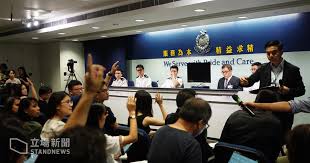
Journalism and politics have great influence in society. They are mutually connected to and dependent on each other. Due to the recent political situation in Hong Kong, the relationship between politicians, including the police force, and journalists has changed. A lot of press conferences were also held these days for reporting and presenting details of political incidents. Clayman and Heritage (2002) mentioned that the linguistic styles in political interviews have changed and “conversationalized” ,and the social distance between politicians and journalists has been reduced. In order to investigate the situation in Hong Kong, we are going to look into the conversation between the police representatives and some journalists during the Q&A session of the police press conference with regard to the “721 Yuen Long Attack” (See the video below). Several interactional patterns that shape their power relations are found by close conversation analysis of the data.
YouTube link: https://www.youtube.com/watch?v=zwr-1vfRgNY
1. Journalists as “questioners” set the agenda
Journalists took the role of “questioners” and restricted what the police could answer in the next turn at the beginning of the Q&A session. They frame the topics and set the agenda of the following interaction by asking questions based on what the general public would like to know.
2. Police resisted by “asking for permission”The police made use of a strategy of “asking for permission” so as to sustain their turn and power. They are aware of the powerful position of journalists within the interaction. However, the police do not do that to simply admit their less powerful position. Instead, this strategy could smartly turn the police from the less powerful position to a position with advantage.

3. Adjacency pairs allowed journalists to re-negotiate the agenda
Adjacency pairs were seen from the interaction when the police requested permission and journalists granted or rejected the approval. Journalists have a chance to re-negotiate the agenda and the power relationships, especially by rejecting the request.

4. Inserted sequences were used by both sides to sustain themselves as “questioners”
Inserted sequences were found throughout the interaction. Both the police and journalists tried to make use of inserted sequences with an attempt to interrupt the turns and sequences, hoping to turn themselves into the questioner.

5. Police made use of “no details in hand” strategy and silence to avoid answering questions
The police made use of strategies like “no details in hand” and silence to avoid answering questions they refused to talk about. When the police said they could not provide answers since they did not have related details or information in hand, it became challenging for journalists to ask follow-up questions and seek further responses. They seemed to have answered the questions but in fact journalists could not get useful information from their answers. Sometimes, they also kept silent when being asked questions that they might not be able to answer.

6. Presence of MC maintains the overall power of the police
The assistance and presence of the emcee, who was in charge of leading the press conference and spoke on behalf of the police force, were crucial for maintaining the power of the police force during the press conference. When the emcee said that they should move on to the closing sequence and end the press conference, the police could successfully avoid answering questions since journalists did not have the opportunity to ask questions or enforce explicitness anymore.

To conclude, the communicative style between the police and journalists is indeed “conversationalized”. However, the power relations between politicians and journalists are inevitably still asymmetrical. Despite the fact that journalists could ask questions and set agenda freely at the beginning of the Q&A session, the press conference was held by the police and they had control over the overall agenda. Therefore, they could interrupt and prevent journalists from asking for more details. Their power could be further reinforced by the strategy of “no details in hand” through which they seemed to have answered the questions but journalists could not get any useful information from their answers.
 Language Culture and Society in Hong Kong (and beyond)