HONG KONG SLANG

by Céline Geliot

During my first day as a waitress in a French bar in Hong Kong, almost all my non-French speaker colleagues spontaneously answered Je ne parle pas français which means “I don’t speak French” when I told them that I was French. But they lied to me. As days passed, I could hear them speaking French as real French people do. They knew every single French insult. They also used French colloquial expressions, most of the time completely out of their context (which was very funny); probably because they just liked to repeat them for fun without caring about their meanings. I tried to teach them words that could be more useful like un verre or sil te plaît (“a glass” or “please”) but it did not work.

My conclusion was that when a language draws our attention but is also too difficult to learn, it is indeed funnier and easier to learn some slang words and colloquial expressions.

Here are a few Cantonese slang expressions I have been taught by young Hong Kongers:

1. Diu (屌/𨳒)

Diu is a common Cantonese profanity which expresses dismay and disapproval in the same way that the English word f**k does. Originally, Diu means “penis” but it has evolved as a verb with expressions like Diulei! (F**k you!) and its highly offensive version Diu lei lo mo! (**** your mother!).

2. Puk gaai (仆街)

Puk gaai is a very common Cantonese curse word. It literally means “falling into the street” and has different actual meanings depending on the context:

a. Puk Gaai! I lost my phone.

    Damn! I lost my phone.

b. It was in your puk gaai bag the whole time?!

    It was in your bloody bag the whole time?!

c. You are such a puk gaai!

    You are such a prick!

d. Go puk gaai!

    Go to hell!

“PK” is also frequently used in virtual contexts.

3. Gong ni di (講尼啲)

Here are some sentences which Hong Kong locals could respond to with Gong ni di?!:

a. Wow. You look really good in your new jeans.

b. Hey! Have you seen my new iWatch 4?

c. Don’t forget to give me my 500 HKD back tomorrow.

d. Do you know that turtles also have a lower shell called a ‘plastron’?

The literal meaning of this idiom is “say these things”. It is the cantonese way of saying “really?!” or “seriously?!”

4. Sing Leh (升呢)

The slang sing leg comes from the gaming culture and means to “level up”.

It is used in many ways to enthusiastically express a positive change or improvement.

For instance: “I found a job. Sing Leh!”

5. Gau Gung (狗公)

Example of situation:

Sara: Seriously Tom, stop spending all your time on Tinder! You told me last week that you were dating Carla. Remember? the Spanish girl…?

Tom:  Carla is not my girlfriend. She is a friend with benefits.

Sara: I was right. You really are a gau gung.

In Cantonese, the customer of a prostitute is called a gau gung. This slang expression is also known to qualifya man who is ready to get all the girls that he can without caring about who they are. It literally means “dog guy” as referring to the idea of a man who just sniffs around everywhere like a dog.

Fun fact: this colloquial expression exists in French slang too! (un mec en chien).

6. Mei mo lui (美魔女)

It means “beautiful witch” and defines the hot older ladies or cougars of Hong Kong.

7. Sau Pei (收皮)

The literal translation of Sau pei is “collect skin”. Close friends use this slang when someone is bragging or bluffing. It is a way to ask him/her to “save it” and stop talking, in a rude manner.

Example:

A: Dude. Do you remember the blond girl we met last weekend?

B: You mean Mary? Of course. Why?

A: I think she’s really into me.

B: Sau pei la!

Addind la makes sure the message is clear.

In other words, sau pei la means: “Stop, just shut the **** up!”

8. Fahn Tohng (饭桶)

Food plays a huge role in the Chinese and Cantonese cultures, so much so that it is also used to insult people! The literal meaning of Fahn Tohng is “rice bucket”. It is used to describe someone who is useless based on the fact that this person only knows how to eat and to hold rice in their stomach and do nothing else

9. Farn xu (番薯)

Calling somebody a farn xu means calling them a sweet potato. It is not sweet as it means that this person is neither very witty nor very clever.

References:

Youtube channels: Carlos Douh, Off the Great Walls, South China Morning Post.

https://sites.google.com/site/hkcantonesedict/home

https://en.wikipedia.org/wiki/Cantonese_profanity

http://unseenhongkong.com/2017/06/10-must-know-cantonese-slangs/https://theculturetrip.com/asia/china/hong-kong/articles/8-colloquialisms-unique-to-cantonese/

How do Cantonese and traditional Chinese act as a recognition of Hong Kongers?

by Janis Ng

“If you want to kill a city, you kill its language.”  Language is a matter of identity.  The interrelationship between language and identity is inseparable.  Cantonese and traditional Chinese are language use of speaking and writing respectively.  Up to this day, Cantonese is still acting as the city’s mouther tongue in Hong Kong.  While traditional Chinese is an official language of Hong Kong.  However, recently some people may argue that both of these spoken and written languages can be replaced by Mandarin and simplified Chinese.  So, what makes them special to represent the identity of a Hong Konger?

  The majority Hong Kongers speak Cantonese as their daily communication tools, is spoken by 89.5% of the overall population.  As the city grown more developed, Mandarin has grown massively in Hong Kong.  Mandarin even become the medium of instruction in many primary schools’ Chinese subject.  However, Cantonese is still standing firm in its premium stage.  Although Cantonese and Mandarin share some words, they have different lexicon, grammar, sentence structure and pronunciation.  And this make them mutually unintelligible. Cantonese’s origin is in Guangdong.  The pronunciation used in Hong Kong Cantonese and Guangdong Cantonese are slight different.  From the 1970s to the 1990s, Cantonese became popular due to the exportation of its language and culture.  People gradually spread the culture via Hong Kong martial arts films and cultural celebrities like Bruce Lee and Jackie Chan.  If you would like to take a deeper glimpse into the Hong Kong art culture, it is better for you to know Cantonese.  Cantonese is a tonal language that has six more tones than Mandarin. The pitch helps you to understand the meaning of the words.  In Cantonese, we have“nine sounds six tones”, gau2 seng1 luk6 diu6九聲六調. 

Figure 1: Kongish

Nowadays, the new generations in Hong Kong use Kongish in their texting language, which is a blend of Cantonese and English, and they use it as a recognition of their identity. Konglish is a double-entendre that make absolutely no sense if you just read it literally.  I am sure that only Hong Kongers can read it.  From Figure 1, it is a conversation between friends, and they are trying to make a time to hang out together.  The first line, “blow blow water with me la” is something like a lead in to start a conversation with your friends.  “blow water” means chit chat, pronounced as “Chui Sui”.  You can imagine the picture of spitting saliva from your mouth while chatting with your friends.

Cantonese is a language of resistance.  Once there is threat to the development of Cantonese, Hong Kongers would preserve it in any possible ways.  In 2010,  the public in Guangzhou initiated a protest to oppose the proposal of changing part of the programming on Guangzhou television from Cantonese to Putonghua.  After the mass protest,  the plan was banned.

In 2014, HKEDB released an article on its website that stated Cantonese is not an official language of the territory.  This caused massive demonstration against what was seen by opponents as an offence to Hong Kong identity and independence. The article was immediately deleted from the website in order to stop the public relation disaster. Cantonese speakers have proven super proud towards their linguistic heritage.

  On written level, traditional Chinese act as a recognition of Hong Kongers. The traditional form of Chinese makes more sense than the simplified one in presenting the real meaning of a Chinese character.

Figure 2: the word “love” in Chinese

Both characters in Figure 2 is the word “love” in Chinese In traditional Chinese, there is a ‘heart’ in the middle of the character.  However, the simplified form of “love”, is without “heart”.  How can we love heartlessly?

  Even the written language of Hong Kong and Taiwan are both traditional Chinese,  they have their uniqueness created by their own language environment. 

The  traditional Chinese of Hong Kong & Taiwan

Although they are different in writing, they are mutually intelligible.  However,  they will be more comfortable to read the text in their own variety style.  

  To Hong Kongers, traditional Chinese is not only structurally beautiful but they have their own specific meaning for each character.

  Cantonese and traditional Chinese act as a recognition of Hong Kongers in terms of their special meaning that only local will fully understand.  It is a heritage of Hong Kong that all citizens would try their very best to preserve.

The Use of Transliteration in Kongish

by Phoebe Ko

Kongish is a new language formed in Hong Kong that mixes English and Cantonese. This language can be seen among Hong Kong’s youngsters, and especially the one with a higher education level. Kongish can be formed by different methods, such as literal translation and transliteration. This blog will focus on the use of the transliteration in Kongish, which only appears in text language, and will investigate the reason that people use this language.

An example of using transliterated Kongish in text messages.

Transliteration in Kongish refers to the process of transferring a word from its Cantonese pronunciation to English alphabet. For example, Kongish users may text ‘Hor yee sik farn lah’ (可以食飯喇), which refers to ‘We can eat now’. Each word in the above example refers to a Chinese word and is romanized by its Cantonese pronunciation. This kind of text language follows Chinese grammar, but not necessarily the Jyutping, a romanisation system for Cantonese developed by the Linguistic Society of Hong Kong. Under the Jyutping system, the word ‘yee’(以) should be written as ‘ji’, where the ‘j’ is pronounced as /j/. However, Jyutping is not taught in schools and we seldom write Kongish according to Jyutping, same as how we do not write English in the International Phonetic Alphabet(IPA). Instead, this type of Kongish should be pronounced like an English word. English speakers can be able to pronounce the Cantonese words by looking at the Kongish version of it, but not understand the meaning of it. Therefore, using this new language actually requires knowledge in both English and Cantonese. For example, the word ‘dim sum’ is also formed by the transliteration of Cantonese. English users can be familiar with this phrase, but do not know what the word ’dim’ and ‘sum’ means. People who speak both Cantonese and English can, however, understand this word easily by pronouncing this Kongish word. The origin of the language is unclear, but according to the above investigation, it is most likely formed due to the bilingual social background of Hong Kong.

Transliterated Kongish can only be understood by people with prior knowledge in both Cantonese and English. The above sentence means ‘Liberate Hong Kong, the revolution of our times’.
(Photo credit: https://www.instarix.org/tag/kwongfukheunggong)

A reason that people use this new language for texting can be to form a discourse community. As mentioned at the beginning of this blog, Kongish is usually used by the younger generation in Hong Kong, especially the 90s and 00s, who lived in a bilingual background since they were born. People can only be able to understand Kongish with prior knowledge of English and Cantonese. Under the education policy in Hong Kong, top schools in Hong Kong are transferred into English as Medium of Instruction School(EMI Schools) which most subjects in these schools are taught in English. It creates a unique language phenomenon in Hong Kong that people from EMI schools can be able to manage both languages. Kongish then becomes the unique language that these people use, while excluding others who do not have the same educational background as they do. Some may say that Kongish is a flaunt of the users’ language ability, but it seems more like a formation of a discourse community which people uses this language to communicate with others that have similar background and values as they do. It also brings Hong Kong people a sense of belonging as there are historical reasons behind the formation of this language and also Hongkongers will understand this language.

Kongish is a product of bilingualism in Hong Kong and should be treasured as it shows the uniqueness of the city. This is a culture among Hongkong youngsters to use this language to communicate, and it helps to build their identity. If you want to join this discourse community, fai d hui hok lah (Quickly go learn it)!

Use of foul language in Hong Kong

by Marco Tsang

If you have lived in Hong Kong for a certain period of time, you may have noticed that people use curse words in their daily conversation all the time. Despite the use of foul language or slang words may be seen as rude and impolite by most of the people around the world, we cannot deny that the existence of foul language is one of the most important elements in constructing a language. Some may have misconception that swearing in daily conversation is the result of poor education and lack of self-cultivation. However, the fact is that the use of foul language is common among HongKongers in different social class. Sometimes we may see an elegant lady who dressed properly and definitely coming from the upper class in Central swears on the street with her friends. Swearing is part of our language and there is no judge about the use of it. 

Picture by Luke Cross

The five most common Chinese characters used by Hong Kong people, when pronounced in Cantonese, are diu (屌), gau (鳩), lan (撚), tsat (柒) and hai (閪). They are considered censored language and forbidden to use on television and broadcast. The first one diu means literally ‘fuck’ in English language. When it is placed in the first of the sentence without other phrases, it expresses the idea of anger, shock, and excitement etc. But the meaning would be changed to disgrace, disrespect and insulting if a subject ‘nei’ (you) is included. Using diu is the most common way of cursing in Cantonese. Yet it is accepted by society to use diu even on TV shows in Taiwan as it has the different meaning of ‘cool’ in their usage. Tracing back to the origin of this word, diu was referring to the male reproductive organ and it has evolved as a verb in 1900s. While diu being the most recognizable vulgar word, the other four words either means sex organs or have a negative meaning. These five words are five strong and powerful vulgar words in Cantonese but it has become more popular and usual in the usage of Cantonese.

Photo retrieved from: https://thestandnews.com/society/%E9%BB%9E%E8%A7%A3%E8%AC%9B%E7%B2%97%E5%8F%A3-%E6%B7%BA%E8%AB%96%E9%80%99%E5%80%8B%E5%9F%8E%E5%B8%82%E7%9A%84%E7%B2%97%E5%8F%A3/

The existence of foul language enriches the attributes of our language. Swearing is the way of indicating the intimacy between friends or in different social groups. It is not hard to find secondary school students, construction workers or even senior workers in an international company using foul language to communicate with their classmates, friends and colleagues. It is a way of establishing the bonding between individuals and it could address the relationship of ‘pal’, ‘mate’. However, this form of showing closeness is restrained between peers or people with similar age only. Of course it is not appropriate to curse with parents, teachers, superior who have a higher social status than us when it comes to swearing.

Photo from the movie Vulgaria (2012)

Swearing is just natural feature of our vernacular which allows us to express our emotions. According to the journal from Language Sciences, it stated that swearing is not a result of limited vocabulary. It is an indicator of healthy verbal abilities instead of covering for language deficiencies. It is what makes our vernacular special and different from standard Chinese language. It should be preserved as it shapes the identity of us being a Hongkonger.

See reference:

https://www.scmp.com/comment/insight-opinion/article/2131022/foul-language-hong-kong-its-not-what-you-say-how-you-say-it

How the use of dialects in Chinese shapes identities differently in Hong Kong and in Mainland China.

by Lorraine Luo

Chinese is the most spoken language around the world which has more than 1.1 billion users.[i] What needs to be clarified is that, the ways to categorize dialects in Chinese is debatable since some think Mandarin is a dialect of Chinese while some argue that Mandarin equals to Chinese. I think both opinions make sense but here we adapt the former view. Though it is not disputable that Mandarin is the standard form of Chinese, it is not the only dialect of Chinese since in Chinese people’s daily conversations they prefer to use their regional dialects rather than standard Mandarin. 


Dialects in Mainland China https://en.wikipedia.org/wiki/Mandarin_Chinese

The most commonly used dialects in Mainland China are Wu, Min, Xiang, Yue, etc. All these groups have their own sub-dialects.[ii] For example, Xiang dialect is a southern group of Chinese dialect which is mostly used in Hunan province. Under the Xiang group there are some sub-dialects such as Changsha dialect, Xiangtan dialect which are spoken in different cities Changsha and Xiangtan. The difference is only the geographical regions and it is common that people from the same regions speak same dialects.


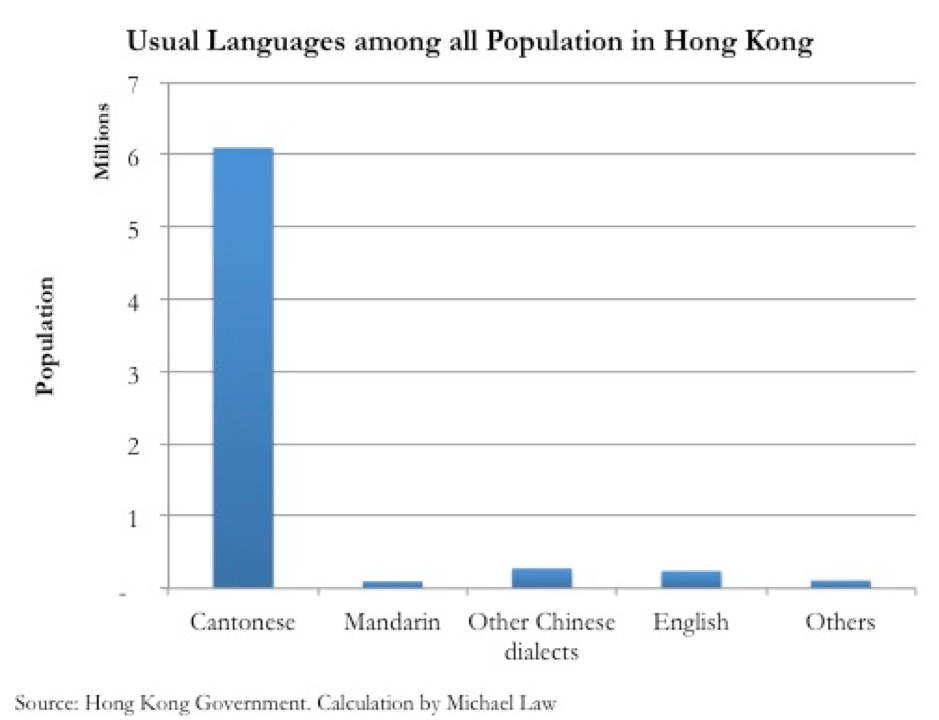
Languages used in Hong Kong https://blogs.harvard.edu/michaellaw/2014/02/19/cantonese-in-hong-kong-not-the-official-language/

As for in Hong Kong, the categories of Chinese dialects are less than in Mainland. The most spoken dialect of Chinese in Hong Kong would be Cantonese which is originated from Guangdong province and adapted into Hong Kong by the earliest immigrants from Mainland. However, even though Hong Kong is part of China, considering its special political situations and colonized histories, its official language is not Chinese but English. So, the use of dialect Cantonese indexes speakers’ identities differently from in Mainland.

In Mainland China, the use of regional dialects can indicate speakers’ social identities of different habitation to differentiate from others (sometimes a sense of priority especially when you are a native dialect speaker in the originated place while others are not). This sense of priority also occurs in the use of dialect Cantonese in Hong Kong when non-Cantonese speakers meet native Hong Kongers. From my personal experience, when you chat with a native Cantonese speaker in Mandarin or English which indicates that you are not a Hong Konger, some natives will discriminate and alienate you.

As we can see, in Mainland the use of different dialects indexes social and cultural difference only to represent a sense of regional solidarity without political implications while in Hong Kong it indexes political identities and may lead to more obvious gaps between speakers because the dialect you speak indicates your political stances and political issues are sensitive in Hong Kong.

Furthermore, with the development of standard Mandarin and its popularization, the dialect use in Mainland China is declining and under this situation, the use of dialects sometimes indicates lower social position and being less educated and this also indexes less formal conversation contexts. However, in Hong Kong, things are different. Same popularization of Mandarin exists in Hong Kong, but the use of dialect Cantonese does not index lower social status or less education. On contrast, it indicates nativity and “purity” since some Hong Kongers reject everything related to the Mainland (according to an online blog survey).[iii

To conclude, even subordinate to the same language, the different dialect use in different areas performs different social identity formation. Some only indexes social and cultural identities while some involves political stances which may lead to interactional gaps at different levels. Also, a common phenomenon is that with the popularization of standard Mandarin, the use of dialects is declining, and inheritance of dialects is in danger. This should arouse people’s awareness of protecting dialects since dialects play a vital role in cultural heritage and historical treasure.

[i] https://www.fluentin3months.com/most-spoken-languages/

[ii] Dialects in China: http://www.mtholyoke.edu/~yu25s/classweb/worldpolitics/Site/Dialects_in_China.html

[iii] Online blog survey: https://www.quora.com/Why-do-Hongkongers-refuse-to-use-Mandarin-and-prefer-speaking-English-and-Cantonese

How social factors affects one to be multilingual in Hong Kong

by Junny Law

Being able to speak multi languages in Hong Kong seems to be a feature of high class, as people think they have more prestige. The ability of speaking in a wide variety of language is influenced by many factors. Where we live, which sex we belongs to and how old we are are the common reasons. In this article, it takes a deep look at these factors and how multilingualism affects one’s impression, the prestige.

(Wong Tai Sin in 1924, Chuk Yuen Village is where Wong Tai Sin Temple stands now. p. 347 of Historical cum Social Study on Kowloon City district in connection with Kai Tak area.)

Firstly, regions show that the use of languages varies across geographical places. With regards to Bacon-Shone, Bolton and Luke (2015), residents in the eastern part of the Hong Kong Island (eastern) can speak English, Cantonese and Putonghua well, while Wong Tai Sin (WTS) residents has the lowest ability. WTS people cannot speak as great and many types as the eastern part since the accessibility of WTS is lower. Many decades ago, it was a slope with many rivers, which was inconvenient to have interactions. Even until now, there remains hills and slopes in that area, like the Diamond Hill, which separates residents to have much connections. Meanwhile, Hong Kong island provides more opportunities to speak these languages even though there are also many slopes. Since Hong Kong Island is a known commercial center, the core for business development, places around Central are the nice accommodations for international elites. With the global perspectives and the diversified culture, eastern residents have better understandings on different languages and even can socialize in multi languages. Therefore, districts affect us to be multilinguals.

Secondly, gender brings effect on being a multilingual. According to the Census and Statistics Department in 2019, men have higher ability to speak different languages totally. Take English and Putonghua speaking as the examples, the differences between the abilities of male and females are the lowest, 1.7%, and the highest, 3.6%, respectively. Shocked by the result, more men can speak Mandarin well, even though the reality gives impressions that many mainland women come and live here and women gossip lots. They seem to know more languages or dialects. However, the fact shows an opposition. Men are better to languages since they are required to talk more formally. For instance, it is a phenomenon that there are more men to say rules in the occupational situations, so they usually interact with others in a more official and formal way. They need to have their speech more carefully. Unlike women, who mainly speak languages to show opinions. Thus, sex is a factor of being multilingual.

Thirdly, the use of languages is affected by ages. Teenagers are more familiar with different languages than the elderly. As stated by Bacon-Shone et al. (2015), there are nearly 60% of the adolescents can speak Cantonese, Putonghua and English while it reaches to lower than 10% at elderly in 2011. There is a continuously decline of the percentage, which means that the younger the citizens are, the higher rate they are the multilinguals. As during 15-19 years old, teens receive education or work in societies, where they receive the up-to-date information and can follow the trends to upgrade themselves, they use and speak more languages. However, the elderly, who may feel satisfied with their life, are not willing to receive further education. Besides, their body functions are poorer that it is difficult to have mouth movements and memorize the languages that once they are used to speak. They do not speak as frequently as the youngers. Thus, whether we can be the multilinguals dependents on our ages.

(See the green line.)

Last but not least, being a multilingual can add marks on the first impression. As speaking more languages can get higher prestige. Oppositely, if one can speak mother-tongue only, it decreases his/her own marks. Imagining you want others help you, but you can express the ideas clearly in mother-language only, with none of the colleagues can understand your language, except the janitor. It is assumed that you will think that the janitor is more educated than the business partners since he/she is the only one who knows you well. It is like seeking help from an uninhabited island. The janitor is the only one who can help you and it is meaningless to scream to other captains. It is noticed that people do not judge others in one perspective, but even consider the language proficiency. We usually want to be like the one who can speak more than 20 languages as we think that the speakers have more power and are in high status. Thus, being multilinguals can give better images and get higher prestige.

In all, there are many social factors affecting us to be multilinguals. While it is not easy to learn every language, it brings advantages to us, especially our prestige. Therefore, it is hoped that we can strive our best to learn different languages.

References

Bacon-Shone, J., Bolton, K., & Luke. K. K. (2015 August). Language Use,            Proficiency and Attitudes in Hong Kong. Social Sciences Research Centre, The University ofHong Kong. Retrieved from http://hub.hku.hk/bitstream/10722/2184 37/1/Content.pdf.

(2019). Demographic Statistics Section (2), Census and Statistics Department.      Retrieved from https://www.censtatd.gov.hk/FileManager/EN/Content_1149/T0     1_12.xlsx.

Ho, P. P., Lo, K. Y., Ng, W. Y., & Lam, S. M. (2009 December). Historical cum Social      Study on Kowloon City district in connection with Kai Tak area. Retrieved from        https://www.heritage.gov.hk/en/doc/conserve/kowlooncityfinalreport.pdf.

Language and a Hong Konger Identity

by Phoebe Ng

Language is a symbol of a civilized society; Hong Kong is no exception. Hong Kong is well known of its diversified culture, we could easily see tourists or visitors with different nationalities on the street, especially in some popular districts like Tsim Sha Tsui, Mongkok, Causeway Bay and Central. Hong Kong as well is an international commercial center where businessmen around the world would come for investments.  Therefore, it is very common to hear “你好” (Cantonese), “ni hao”(Mandarin) and “hello” in greetings as well as the three languages in railway (MTR) announcements. 

人们在横过旧香港的繁忙街道上。在香港斑马线上行走的人.
Picture credit: Bumble-Dee. (n.d.). https://cn.depositphotos.com/146599171/stock-photo-people-crossing-on-the-busy.html.

In the recent decades, the competitiveness in education industry in Hong Kong has increased greatly due to the fact that there are more people coming from Mainland, trying to get a seat in Hong Kong institutions, including kindergarten, primary, secondary and even tertiary sectors. Living under a more competitive environment, parents are believed to start training their children to be more outstanding. Learning a second or third language is one of their strategies. People who was born after the 1900s are encouraged to study more than one language in order to avoid elimination and to cope with the fast pace of the advanced society. Children in primary schools, and even kindergarten have started learning a second language besides their mother tongue—Cantonese. It is believed that people who learn more than one language in Hong Kong is more well-educated and may be able to get a well-paid job. English and Mandarin are therefore some of the top choices to be the second and third language of Hong Kong students. 

Our Mother Tongue

What about Cantonese?

Cantonese is a dialect rather than a language, it is used in Guangdong, Hong Kong and Macau at present. It is the mother tongue of most Hong Kongers after the handover since 1997. There are Cantopop developed later on. Apparently, Cantonese is the mother language that a Hong Konger must learn. Due to the fact that Mandarin is being heavily promoted in different parts in Mainland China after the communist had taken over in 1949, as a result, people are no longer familiar with Cantonese. To pass on the culture of Cantonese, as a Hong Konger, we have the responsibility to preserve Cantonese as a part of our daily life. It can A fun fact on Cantonese: Many Hong Kongers agree that using Cantonese, especially on foul languages can better express themselves and is succinct enough to express that specific feeling. Although Cantonese is a dialect, it is powerful as of a language that it also includes different kinds of sentence structures, its pronunciation may even be more complicated than other languages in most the worlds that includes 9 tones of a word. Cantonese does not only perform to be the symbol of local identity in Hong Kong but also the preservation of Chinese Language history. 

Why English?

It is no doubt that English is the international language of communication. By learning English, we can communicate and connect with people around the world easier, for example, Japanese, Australian, Canadian etc. Take a daily example, we can provide help for foreigners on street easily if we know English. We may also make friends with different backgrounds by communicating in English, especially in international schools and universities. Furthermore, English is the language of Business. As a part of the commercialized community, Hong Kong people should surely possess the ability to speak fluent English as their second language which would at the same time, enables Hong Kong businessmen to cooperate and make transactions. Moreover, most Hong Kong people also believed that learning English can help to find a well-paid job such as teachers, doctors, lawyers, translators…These all resulted that English is another language which a Hong Konger should master. 

Why Mandarin (Putonghua)?

After the hand-over in 1997, the HKSAR government has implemented the concept of “Bi-literacy” and “Tri-lingualism”. “Bi-literacy” includes Chinese Language, English Language while “Tri-lingualism” includes Cantonese, English and Putonghua. Other than English, Putonghua is another language that a Hong Konger should possess. Geographically, Hong Kong is very near to China where Mandarin is the main language used there. According to the Sino-British Joint Declaration in 1997, Hong Kong is being returned to the China. As a part of China, the HKSAR believed that it is necessarily for all Hong Kongers to be able to speak fluent Putonghua. In the recent years, under the government policies, there are more and more mainlanders coming from Mainland China to Hong Kong for visiting and receiving education mainly. With the influence of the immigrants, schools are opening classes to suit the needs for Mandarin speakers, sooner, Putonghua becomes one of the common languages that one may come up with in daily life. With the reasons above, it is proved that Mandarin is a language that a Hong Konger should equip. 

References:

https://www.elc-schools.com/blog/4-reasons-why-learning-english-is-so-important/