The dynamic power of stand-up comedy: from humor discourse to society

by Doris Hui

A stand-up comedy show is presented by a solo performer talking directly to the audience in terms of humor and joke. It requires our language understanding to enable simplify communication as well. It can be exploited as an effective means of persuasion to influence the audiences or raise their awareness of some consequent issues. The stand-up comedy becomes more attractive because the comedian is producing jokes that mostly relies on speaking proficiency or the content rather than body language (as cited in Badara, 2018). The audience is more likely to listen to a story directly instead of reading it. 

In Hong Kong, Dayo Wong Tsz-wah is a famous stand-up comedian. He always introduces a mass of political and philosophical content in his comedy show by using “humor”, which carries a high level of consonant among the audience. Examining the humor discourse in Dayo’s stand-up comedy show has particular characteristics in terms of its creation and language use. We can see how Dayo uses humor techniques to resonate deeply with the Hong Kong audience. 

In 2018, “Wong Tsz-wah 15th comedy show: farewell performance” was held in Hong Kong, which was Dayo’s last performance in his career life.
(Picture source: http://www.orientalsunday.hk)

(01) “點解要叫佢地「武警」?並唔係武力個「武」,而係伯母個「母」,因為係香港做警察嘅首要條件就係要比人問候伯母。” (“They should not be called as “armed police” but “mother police.” )                                                         (Data of stand-up comedy discourse, 2018)

Dayo plays an ambiguous expression on “mother police” (“母警”) which can make the audience laugh. He compared “armed police” to “mother police” because their pronunciation is the same in Cantonese but the meaning is entirely different. The police officers were scolded by the citizens for the violent dispersal in the demonstrations. In Cantonese’s foul language, a highly offensive expression is to mention someone’s mother. Therefore, Dayo suggested that the police should be called “mother police” since the protesters always use offensive language to express their dissatisfaction with the police officer. 

In 2014, “Wong Tsz-wah 14th comedy show: Crazy right now” was held by Dayo.
(Picture source:www.hk01.com)

(02) “而家香港嘅問題,係婆媳糾紛,……除非你老婆第一日入門就全心全意同奶奶講:……「阿媽,我愛你!」……” (“The conflict between Hong Kong and mainland China is just like the mother-in-law’s dispute. Would the son’s wife says “Mum, I love you so much” sincerely to her husband’s mother?”)                                           (Data of stand-up comedy discourse, 2014)

The statement is an ironic speech, which is a statement that means opposite to what it says. Here is a good comparison to describe the relationship between Hong Kong and Mainland China nowadays. Mum is representing China, and the son’s wife is representing Hong Kong. The conflicts between them mostly come from the problems of “new immigrants”.  The number of tourists from Mainland to Hong Kong has continually increased and the problems of “competing resources” are even more extended. However, neither the Hong Kong government or China, is considering carrying out any suitable policies to develop a mutually beneficial development. Dayo commented, “Mum, I LOVE YOU so much” is an irony since there is no suitable expression that people will have a supportive statement to your “enemies”. The discourse is supported by the political backgrounds which can emerge as irony as well as causing humor. 

In 2003, “Wong Tsz-wah 8th comedy show: useless” was held by Dayo.
(Picture source: http://timable.com/)

(03) “尊嚴幾錢啊?而家『粗鹽』都貴過『尊嚴』啦!” (“Nowadays, the price of “coarse salt” is much higher than the price of our “dignity”!”) 

(Data of stand-up comedy discourse, 2003)

Dayo compared “coarse salt” to “dignity” since the pronunciation of these two words are similar in Cantonese, and “coarse salt” compared to the commodity price in Hong Kong. The expensive cost of living in Hong Kong has put a heavy burden on the citizens in daily life. This humor discourse emerged laughter because Dayo used metaphor by comparing the commodity price to inanimate objects. Also, it is a satire that the price of an inanimate object (“coarse salt”) can be entirely higher than the value of our “dignity” in Hong Kong. 

In a nutshell, stand-up comedy is easy for the audience to see how the human events as open to change, contingent or not at all certain. Dayo created and participated in most of the dialogues with humor, philosophical elements, and irony. The stand-up comedy show held by Dayo Wong Tsz-wah can carry a high level of consonant among the audience, and it also has the power to raise the audience’s awareness of the local phenomenon and social issues. 

Discourse Analysis of Propaganda from Social Media in Hong Kong Context Regarding COVID-19

by Aaron Chan

COVID-19 is an infectious disease caused by coronavirus, a family of viruses which can lead to severe respiratory syndromes (SARS) which have taken away millions of lives. In Hong Kong, there are over one thousand cases, with the first case confirmed on 23rd January, 2020. Before the outbreak in this international city, Hong Kong citizens, who are mostly technologically literate, have already got updates about the pandemic through different sources. It is commonly agreed among those Hongkongers that the pandemic is from Wuhan, China, and together with the political movement against the Hong Kong government, those Hongkongers are active in producing propaganda and spreading the news that China is an evil country. In this article, political stances and opinions will not be the focus of discussion. Instead, the language and the images of related propaganda will be the main talking points. 

Among the propaganda, most of the pictures employed ironic and humorous ways to express their dissatisfaction towards the government or related authorities, or to convey the message that COVID-19 is originated from, or even made in China. As the virus is identified after a series of political movements against the introduction of Extradition Bill in Hong Kong, the propaganda often involves elements about the political ideology of the creators. Figure A is an example of the propaganda mentioned above. 

Figure A

In the left-hand side of the graphic, the woman standing and talking is Carrie Lam, the Chief Executive of Hong Kong. She once infamously said, ‘it was no longer meaningful to close the border.’ This is exactly what first line of the texts in bottom left means. In the second line, ‘攬炒之母’ means ‘the mother of mutual destruction,’ which is used to describe Carrie Lam action is destroying the whole Hong Kong. 

            Solely from these texts, we already know that there is some sort of dissatisfaction from the creator of this graphic and those who have the same stance. If we are to analyse this with the definition in (3-2), it, obviously falls into the aspect of satisfaction in Appraisal– the creator wants to convey a sense of anger through writing ‘攬炒之母’. In the right-hand side of the picture, there are a lot of green zombie-looking objects, rushing through a door, above which is a sign with simplified Chinese, meaning ‘welcome’ Those ‘zombies’ symbolise mainlanders who rush to Hong Kong for shelters as mainland China has been regarded as a dangerous place even by the mainlanders. The sign of ‘welcome’ is an irony addressing Carrie Lam’s rejection to close the border. In this context, the creator of the graphic wants its audience, who are generally Hongkongers, to apply judgement in Appraisal – to think that Carrie Lam acts in a reckless way (tenacity), if not an immoral way (propriety). This is, overall, an effective picture with its implication well conveyed. 

            Figure A is only an example of such propaganda against the government. The picture is extracted from https://wars.vote4.hk/poster-gallery, from which a lot of pictures are worth analysing. Humour and irony is often used to express the hopelessness and ridiculousness in the users’ eyes. Propaganda, albeit biased, is a good way to spread ideology and use humour and irony to express opinions. 

Power Relations Between Police Officers And Suspects

by Sam Chan

Have you ever rejected your doctor’s prescription or your boss’s order? The answer would mostly likely be no. It is common and natural for us to obey and listen to others who have higher status and are more knowledgeable than us. Unlike doctors and bosses, who have power over certain kinds of people, police officers have power over every citizen despite their social identity and status. This is not just about the power of arresting you or controlling your action, it is also about the power on the language level. Police officers use different language strategies during interrogation to control the topic and process of the conversation. 

We are going to look into the asymmetrical power relations between police and suspects by analyzing a video of an authentic interrogation between an American police officer and a Dubai Lamborghini driver. 

YouTube link: https://www.youtube.com/watch?v=Q1DCda5Cabo

Interruption

The police officer interrupted the driver for 15 times in their short 5-mintue conversation. Power-oriented interruptions are made to change the discourse from the speaker by gaining control of the conversation content and/ or process. It usually includes topic change attempts achieved by requests and questions (process control strategies) or by statement or assertions (content control strategies), the latter being less face-threatening. There are 2 kinds of power-oriented interruptions shown in this video. 

  1. Content control

D: It’s a temporary import.

P: It’s a what?

D: It’s a TEMPORARY import. It’s not a permanent thing, we fly our cars here, we do our trips and we fly them back, that’s how it works. 

D: I know it’s confusing [but-]

P:                                                             [No,] it’s not confusing it’s very simple. Alright? If you have some sort of import, that that’s to get into the country, OK?

D: I’’ll- [I’ll-]

P:                [Let] me see what you have that says you can drive it on the road in Oregon.

D: You will understand in a second.

P: Pardon me?

D: You’re gonna understand in a second, I’m gonna [provide-]

P:                                                                                                                           [I’m] pretty sure I know what I’m talking about right now.

The police repeatedly assured the driver that he was not confused and knew what he was talking about, whenever the driver mentioned the complicated documents. The officer was attempting to reassert his dominating position as a role who has expertise in this area. 2.

2. Process control

P: D: A EPA exemption and then a Carnet De Passage.

P: Do you have any of that?

D: Of course yeah, I’m gonna [provide everthing-]

P:                                                                          [Do you have] something that says you can drive this car on the road?

D: Yes sir.

When the driver explained to the police how he could legally drive in the US for multiple times. The police interrupted his explanation and shifted the focus on providing permission and insurance. The police held more power in the process of the conversation. 

Resistance

The Lamborghini owner has a high social status and has experience in travelling in his own car. He attempted to resist to the power and control of the police by asking questions towards the end of the interrogation using two strategies.  

1. Asking question

D: Alright, why are you being so defensive? I’m trying [to-]

P:                                                                                                                                      [Pardon] me?

D: Why are you so defensive? I’m trying to [provide-]

P:                                                                                                             [No,] I’m just asking for these documents and you won’t quit talking about other stuff.

In a police interview, the police typically is the one who asks question. However, the driver reversed the questioner-responder roles and tried to gain some control. 

2. Direct accusation

A police officer should have full knowledge of the laws and regulations. In this case, the police seemed to be confused of the kinds of required documents. Therefore, at the very end of the video, after the driver provided the necessary documents, he challenged the police’s position by saying that police didn’t know the federal law. 

P: Here-here’s your stuff here. You gotta get a temporary permit, OK? I have another call I have to go [to.] Be safe pulling out into traffic.

D:                                      [Sir…]

D: It’s a federal law, you don’t know the law. To conclude, police has more control and power over a discourse due to their identity as a law enforcer and professional knowledge in rules and regulations. Yet, the police is not always right. Citizen, who has less power in default, can also attempt to overthrow the imbalance power relation. Through this analysis, I hope the issue of extremely imbalance relation between the Hong Kong police and the protestors could be brought to public attention.

Effectiveness of Hong Kong social movement propaganda on social media

By Anthony Lee

In 2010, Jasmine revolution broke out in Tunisia. The situation of protesters being brutally suppressed by the police force was broadcasted on social media. This raised public anger and people’s compassion towards the protesters. As a result, the social movement earned more support. The ideas that tyranny can be defeated through civilians’ resistance even encouraged the revolution in many other Arabic countries, such as Syria, Yemen, Algeria, Saudi Arabia. Social media was proved to have an important role of encouraging the social movement.

In 2020, large scale protest also broke out in Hong Kong. Protesters actively used social media to spread their ideas and ask for help. Would social media be influential as it was in the Jasmine revolution?

Propaganda of Hong Kong social movement

In informative propaganda, speakers focus on sharing facts and information to others. A great number of them shares about police brutality. They describe how Hong Kong police has been handling the movement inappropriately:

In Emotional propaganda, the words affect the audience emotionally. Most of them encourage protesters to insist, or raise public anger on the police and the government.

In ironic propaganda, words are used to mock at the absurdity on the views of the opponents, while exaggerating the logical flaw of them:

Effectiveness

For informative propaganda, I believe some of them could be too tiring for people to read. P2, for example, is full of words and it looks likes news. P1 also have too many words in total with a small font, which is not friendly for elderly or uneducated people to read. They may cause compassion Fatigue[1], which makes people feel like the bad news are happening on themselves. Victims of compassion Fatigue feel that they must do something to help the others, otherwise they will bare sense of guilt or sense of helplessness. In order to prevent these negative feelings, many people would hate reading propaganda. 

For emotional discourse, I believe they have few actual impacts on the movement. While many social media users ask for revenge on the police, the police receive few formal complaint, compared to those on the internet. As a result, few of their misconduct are investigated as many of them lack a complainer. As Chiluwa& Ifukor (2015) stated in their research on #BringBackOurGirls campaign, these propaganda are purely slacktivism. People pressed the like button and felt like they made a contribution, but there is few impact except making themselves happy.

For ironic propaganda, they are difficult to understand. A forum user[2]states that his mother did not understand the irony in P5. She sincerely believes that the content of the photo is true and she had worse impression on the protesters since then. It proved that some people cannot see the flaw implied by the irony and is an irony is only comprehensible to people who support protesters. They are not effective in asking the opponents to change their views.

Conclusion

Comparing to #BringBackOurGirls campaign studied by Chiluwa& Ifukor, the promotion in Hong Kong is more successful in urging for concrete action. However, these propaganda is still the minority. Within three major types of discourses, informative propaganda is boring, emotional discourse is impractical solutions, and ironic propaganda is hard to understand. To create propaganda that is more effective, writers should pay more effort making their discourses interesting, specific and simple.

References

Chiluwa, I., & Ifukor, P. (2015). ‘War against our Children’: Stance and evaluation in      #BringBackOurGirls campaign discourse on Twitter and Facebook. Discourse & Society26(3), 267–296. doi: 10.1177/0957926514564735

Freehongkong. (n.d.). Retrieved from            https://www.facebook.com/pg/freehongkong2019/posts/?ref=page_internal LIHKG. (n.d.). Retrieved from https://lihkg.com/thread/1476374/page/1

200008. (2019, November 11). 【吹水台】[認真問]有無D文宣勁少少,易吸收既     Facebook page?? by 200008. Retrieved from https://md.hkgolden.com/view_amp.aspx?message=7142353&page=1

香港加油文宣站. (n.d.). Retrieved from       https://www.facebook.com/102716824426741/posts/102723374426086/

全民罷買日 Bye Buy Day HK. (n.d.). Retrieved from         https://www.facebook.com/byebuydayhk/posts/179510303407422

金水2 – 黃金同路人. (n.d.). Retrieved from             https://www.facebook.com/116734329726606/posts/147802233286482/

[1]張玉如 (2020, March 26). 【心理健康】對負面消息感麻木 關心人反而易患「情感疲勞」?. Retrieved from https://www.hk01.com/健康/389178/心理健康-對負面消息感麻木-關心人反而易患-情感疲勞

[2] 200008. (2019, November 11). 【吹水台】[認真問]有無D文宣勁少少,易吸收既   Facebook page?? by 200008. Retrieved from https://md.hkgolden.com/view_amp.aspx?message=7142353&page=1

Where reverse discourse meets advertising discourse: A parody poster against police brutality

By Jacqueline Tsang

Fairclough (1992) pointed out that a text is interdiscursive when it illustrates “an instance of mixing of genres, discourses and styles”. A parody poster against police brutality designed by Hong Kong netizens demonstrates how reverse discourse mixed with advertising discourse to spread the message – say no to police brutality, in a combination of verbal and visual modes.

In early November, the government released a series of posters asking citizens to stay away from violence. In other words, they spread a message that citizens should never support these violent protesters or rioters. To resist the dominant institutional discourse, the pro-democratic side released a parody poster in which the mainstream slogan and the ideology behind (stay away from violence) were adopted. Smartly through this revers discourse, they turned the mainstream opinion into one that spreads the subordinate belief. Additionally, the poster also shows some aspects of advertising discourse, which helps to intensify the message behind.

The slogan

In the slogan, the designer used the same vocabulary暴力to point out a counterargument. The designer also acknowledged the public notion that there were violent acts throughout the protest. However, with the use of reverse discourse, such violence no longer comes from the protesters, but the Hong Kong police. This allows the poster not to be argued by the mainstream; meanwhile, it challenged the current power structure by pulling down the police’s status from a powered discipline service team to a group of beasts doing violent acts.

Moreover, readers are directly addressed through the use of imperatives. According to Simpson, Mayr and Statham (2019), these imperatives allowed the designer to engage Hongkongers “on an individual basis” as if they are having a conversation with the designer. It is, therefore, more efficient to convey the message that citizens should stay away from the police in order to avoid violence.

The parallelism also intensified meaning. The repeated structure of an imperative starting with a phrasal verb turned the slogan to be a more melodic and rhythmic one, as well as intensifying the message behind – stay away from the police.

The faceless photo

Stepping on the protester’s head, the riot police seem to be the powered in the photo. Nevertheless, they are collectivised as a cold-blooded, unprofessional, “homogenous community” who is not performing the duty of protecting the citizens but hurting them (Calsamiglia and Ferrero, 2003). This, in turn, weakens the professional image of the whole police force. The collectivisation also reinforces the message that the riot police are all unable to make a judgement as they lack autonomy once they become a group.

Contrastively, the lone protester is individualised and humanised. Although he/she is powerless in the picture, the protester is still “personalised”, and thus readers are likely to regard them as a reasonable agent who could have enjoyed more autonomy if he/she had not been stepped at his/her head (Bernard, 2018).

Simpson, Mayr and Statham (2019) pointed out that “what is absent in a text is just as important”. It is therefore important to look at the missing facial expressions of both parties in the photo. The absence of faces of both the protesters and the riot police distances the social actors from readers. As a result, readers might have no feeling of the incident. However, such absence could also imply a warning message that the social actors in this photo, both the unfortunate victim on the floor and the brutal perpetrator, could actually be any of us. The designer, indeed, wanted to intensify the overall meaning to persuade the audience to choose wisely (by staying away from the police as encouraged in the slogan) so that they will not become similar to the violent police, nor the being beaten up by the riot police.

The layout

The simple layout here agrees with Kress and van Leeuwen’s notes on the idea of “Ideal” and “Real”. In the poster, the more generalised idea about violence is put as a logo on the top while the more “factual, down to earth information” is placed at the bottom. Such logical layout indeed helps readers to first grasp the more “frivolous” idea before knowing what exact actions they have to take (as demonstrated in the slogan).

Colour choice

The red colour, which reminds readers of blood or danger, was used with words violence as well as the term police. This fosters the message that the police force equals to the origin of violence in the protest. Contrastively, black colour is used in the background. Practically, it helps readers to focus on the photo and the slogan as a black background “make the other colours stand out”; while ideologically, it symbolises the dark side of the disciplined service team, as well as the dark future, or even the death of Hong Kong’s political environment.

Conclusion

The designer skilfully demonstrated a reverse discourse by turning the mainstream objection about protesters’ violence into an accusation towards police brutality. The visual elements, particularly the photo which personalised protesters, also reinforce such message. The lack of facial expression of both social actors allows readers to reflect on which side they should take. As a consequence, the poster might affect the current power relations that more citizens might be aware of police brutality and switch their side to support the protesters.

References:

Bernard, T. (2018). The Discursive Representation of Social Actors in the Corporate Social Responsibility (CSR) and Integrated Annual (IA) Reports of Two South African Mining Companies. Critical Approaches to Discourse Analysis across Disciplines, 10(1), 81-97.

Calsamiglia, H., & Ferrero, C. (2003). Role and Position of Scientific Voices: Reported Speech in the Media. Discourse Studies, 5(2), 147-173.

Hariman, R., & Lucaites, J. L. (2007). No caption needed: Iconic photographs, public culture, and liberal democracy. University of Chicago Press.

Simpson, P., Mayr, A., & Statham, S. (2019). Language and power: A resource book for students (Second ed., Routledge English language introductions series).

Hong Kong Police Force versus Hong Kong Citizens: Power Asymmetry in Discourse

By Chan Ka Hay, Gladys

Hong Kong Police Force (source: Reuters)

An institution is defined as “an interlocking double-structure of persons-as-role-holders or office-bearers and the like, and of social practices involving both expressive and practical aims and outcomes”. In institutional talks, there are asymmetrical speaking rights and obligations for the two sides. The asymmetry in power is demonstrated through the ability for the one of the higher rank to discipline, regulate, or even punish the lower rank. This asymmetry of power could be observed in the interactions between citizens and officers of different police institutions in different countries. 

The Hong Kong Police Force (HKPF), with no exceptions, has demonstrated institutional talks on multiple occasions towards local citizens. Since June 2019, there has been a wave of democratic movements in Hong Kong. There are frequent conflicts between HKPF and local protestors or citizens. During the conflicts, there are several recurring features in the discourse between the male officers and female citizens.

Vocabulary

Term 1: Angel (天使 / tin1 si2)

Fanny Law (source: RTHK News)

Tin1 si2 means “angel” in Cantonese. However, in Hong Kong, the word has an overtone, meaning “young females that provide sexual services”. The term is first introduced by Fanny Law, member of the Executive Council, stated on air publicly that she received confirmed information about the so-called “frontline angels” in the movements. The concept of  “frontline angels” has been circulated among the pro-government camps. Since then, the term tinsi has frequently been used to insult female pro-democratic protesters.  

Term 2: Liberal cunt (自由 / zi6 jau4 hai1)

The term zi6 jau4 hai1 was first used by an officer of the Special Tactical Squad (STS) of HKPF in June 2019. This is a combination of “freedom / liberal” and “cunt” in Cantonese. In Cantonese, “閪” is a profane word with the meaning of vulva, which could be directly translated into the swear word “cunt” in English. Recorded in a video clip, the STS officer shouted the term towards the crowd of protesters, who were behind a locked glass door of a shopping mall. 

(source: vechk.wikia.org)

Different from the first term angel, this term includes a Cantonese swear word. This could be identified as abusive swearing. According to Pinker (2007), it is used with the intention to offend, intimidate, or cause harm emotionally or psychologically to the target listener.

ContentVerbal Assault 

Verbal assault could be observed in the above examples. Bosch (2004) suggests that the methods of verbal assault are used in order to weaken, control, and manipulate another person to create shame, humiliation, hurt, and anger. 

The name-calling strategy is used by the HKPF officers by assigning names with sexual overtones like “angel” or “liberal cunt” to female citizens, the HKPF officers’ attempts of belittling their target through the sexual aspect. 

Content: Control of Topic   

According to Bajner (2006), men are trained to capture power in their interactions, therefore they tend to make attempts to control the topic, even when they only have limited knowledge about the topic. In addition to the institutional power they have as police officers, there are obvious attempts for the male HKPF officers in trying to control the topic. Despite the aim of their speeches is to command the citizens to leave, the irrelevant and sex-related words like “angel”, “cunt” are used by them. Their identities as police officers and male are advantageous for them to control the topic more easily, especially for the act of redirecting the topic from requests for citizens to leave to groundless sexual accusations towards female citizens. By the topic redirection towards the aspect of sex, the male officers of HKPF were in the upper hand in the conversations.

Conclusion

There is a tendency for male officers of the HKPF to employ speeches with sexual overtones towards female citizens. Both verbs (“get fucked”) and nouns (“cunt”, “angel”) used in their speeches are sexually provoking. These preferences of words could be seen as a demonstration of the power of the identities as male police officers.

From the language used by the HKPF in the conversations with female citizens, there are demonstrations of power as both a police officer and a male in the society. These cases have provided evidence of the existence of verbal assault from the officers of the HKPF towards the local citizens, especially towards females. Female citizens, as the disadvantaged side in the asymmetry of power in the aspect of institution and sex, became the easy target of verbal assault of the HKPF officers. 

Power Asymmetry in Doctor-Patient Interactions

By Carrie Chan

As citizens, we must have had certain experience in medical encounters or interactions in our daily lives. In institutional talks like business meetings, doctor-patient talks and political interviews, ‘institution’, ‘discourse’ (language) and ‘power’ are interconnected and language serves as the ‘principal means by which organizational members create a coherent social reality that frames their sense of who they are’ (Fairclough & Wodak, 1997, p. 181). Besides, every participant in institutional talks possesses specific goal orientations in order to match with their social roles. However, we might not be aware of the fact that power asymmetry does exist during the interactions since linguistic resources are employed in the process to make the power differences seem ‘pre-inscribed’. In that case, we as patients are usually at a more ‘inferior’ position while the doctors are more powerful since they possess the professional knowledge in medical science.

In fact, in the realm of language and power, a combination of Conversation Analysis (CA) which studies talk-in interactions at a micro-level as well as Critical Discourse Analysis (CDA) which places the emphasis on describing, detailing and analysing linguistic features during talks could be used to help unfold the ‘generally hidden determinants’ during social interactions (Simpson et al., 2018). With these two methods, some common linguistic features that demonstrate the power asymmetry are found in doctor-patient interactions. They are ‘Topic control’, ‘Enforcing explicitness’, ‘Interruption’ suggested by Fairclough (1989, pp. 135-137) and a rhetorical device called ‘hedging’.

Topic Control

During the consultation, the doctor is usually the one controlling the sequences using a cycle of questions to elicit responses from the patient and the patients are bound to answer them. When answering these ‘closed’ questions asked by the doctors, the patients’ contributions are restrained since they are limited to say ‘Yes’ or ‘No’ or give brief responses.

Enforcing Explicitness

Patients as the less powerful speakers are usually asked to disambiguate the responses, explain with further details and make the ‘vague’ answers explicit. In order to cooperate and meet the social goals, the patients have to provide a clarification and be enforced to describe their conditions as requested by the doctors.

Interruption Interruption indicated by speech overlaps is also commonly found in everyday talks as well as doctor-patient interactions and it is somehow regarded as ‘normal’ and ‘natural’. For example, when a patient is making his turn or answering the doctor’s question, the doctor may interrupt without allowing him or her to finish the turn since the doctor knows what might be an ‘adequate’ answer for him to do the diagnosis.

Hedging

Apart from the above three devices, ‘Hedging’ is a linguistic device used by the patient where a mitigating word is used in the utterance to soften the tone or certainty (Brown & Levinson, 1987). Sometimes when patients are describing their conditions, words such as “I think” or “like” are used to hedge their speeches. Even though the patients possess the ‘superior knowledge’ about how they feel, they still choose to hedge the speech by uncertainty markers to downplay the certainty without ‘challenging’ the doctor whom they think possess professional knowledge in giving diagnosis.

From the above devices identified in doctor-patient interactions, it is shown that they serve as good examples that illustrate how power asymmetry is being ‘naturalized’ in institutional talks. Even patients possess ‘superior knowledge’ of how they feel, they would still align with the mainstream thinking that doctors are the more powerful figure during the interactions since they have professional recognition in medical science. Through critically picking out details from the above talk-in interactions, asymmetrical speaking rights, obligations and power differences in institutional talks could be brought to light.  

A Critical Discourse Analysis of the 2016 US Election TV Debate

by Peifeier Rao

This article will analyze the language strategies used by Hillary and Trump and the ideological significance hidden behind their language from the perspective of critical discourse analysis (CDA). When focusing on the text, it gives more attention to the choices and patterns in vocabulary. The following context will mainly analyze the text itself from three aspects: the use of personal pronouns, transitivity and metaphor.

From the use of personal pronouns, the choice of different titles reflects the attitude and ideology of speaker. This article selects the first topic of the first TV debate, achieving prosperity, to count the frequency of personal pronouns used in it:

Personal PronounsI/me/myYou/yourWe/us /ourThey/them/their
Clinton94537417
Trump89999044

It is clear that the frequency of the first-person plural form “we/us/our” in Clinton and Trump’s discourse is ranked second. Both they used the first-person plural form “we/us/our”, narrowed the distance between the speaker and the voters, and won goodwill. “I/me/my” as the most used personal pronoun of Clinton, indicates that Clinton is more expressing her political views and showing her political wisdom, while Trump uses the second person “you/your” most, which refers to different objects.

Transitivity expresses people experience and knowledge in reality and the inner world and points out the participants and environmental components in various processes. The article also cites the first topic in first debate, achieving prosperity, to compare:

Material processMetal processRelational processBehavioral processVerbal processExistential process
8079760125
100461550164

In terms of transitivity, Clinton used material processes, using a lot of real verbs to explain the measures she would take to achieve American prosperity, showing her political ability and self-confidence, thus winning more support. Trump often uses the relational process to show his understanding of the current state of the US economy and dispel voters’ doubts about him.

Metaphor is an important information processing tool that can simplify a large amount of complex and abstract information into easy-to-understand language, so that voters can better understand and accept, narrow the distance between candidates and voters, and achieve good political advice admonishment effect. There are four most important metaphors in election debate. The travel metaphor maps the characteristics of travel to the target domain, which is widely used in political speech and is a representative conceptual metaphor: Developing a country is a journey. The war metaphor maps the characteristics of war to the target domain. Architectural metaphor is to map the characteristics of architecture to the target domain, which has a corresponding structure and structure in terms of organization and internal structure. Body metaphor also become an important political metaphor for explaining political terms. It considers country/city as a human being, possessing human character and physiological status. Human organs are also used to refer to the different structures and functions of countries and organizations. The various use of metaphors in Clinton and Trump’s political speeches and debates not only helps explain and express their own ideas, demonstrates your strengths, but also helps voters understand political terms and make more sensible and clear choices.

In conclusion, the organization and wise use of language can effectively help candidates communicate their ideas to voters and attract them to vote more for candidates. By analyzing the linguistic elements in the television debates between Clinton and Trump, we can find the two speakers’ completely different speech styles and their ingenious intentions during the campaign.

Understanding power relations in the institutional language context: Carrie Lam’s official statement on COVID-19

by Lorraine Luo

Social institutions are all around people’s lives and they have the immense power to control and shape how people talk and think in particular ways. The government is one of the most significant social institutions and the governmental language discourses reflect the institutional power relations between the participants and in turn are shaped by the power control (Mayr, 2008).

The outburst of the COVID-19 epidemic is one of the hottest topics recently world-wide. Hong Kong had been through a tough time defeating this disease and the chief executive made her official statement through her website on January 25th, 2020 to report the government’s recent control measures, to explain the current situations, and to encourage the citizens to stay strong together fighting the decease.

(Article link: https://www.ceo.gov.hk/eng/pdf/article20200225.pdf)


(Picture source: Youtube.com)

Through the Critical Discourse Analysis on this text, it can be discovered that the textual elements are carefully designed: formal expressions and precise grammar such as “we dare not underestimate its severity” (line 9, page 1), “accorded top priority” (line 1-2, page 4) and a variety of subordinate clauses are applied in this decent governmental official article. These textual factors present how the governmental chief pays attention to her manners of speaking/writing in order to perform appropriately as the chief leader. Also, the discursive variables in the CDA of this article suggest that the institutional language discourses apply nominalizations (“Multiple measures are taken…”, line 12, page 1) to mitigate the agents of the activities/issues and this is a typical official manner of speaking since the governmental spokespersons need to avoid giving out too many details of the administrative information which are confidential. Apart from that, Carrie Lam in the last paragraph of this article encourages the citizens using a direct quotation from an expert who dedicated himself to the battle against the epidemic. This is another discursive practice of intertextuality to increase this article’s authenticity and the power of persuasion. Last but not least, Carrie Lam in this article is reporting on behalf of the HKSAR and she takes the role as the representative of the government in the stance-taking analysis. Therefore, she speaks in a formal and official tone and this indicates the power distance between the participants (the government and the citizens).

What’s more, the information content in this article has been filtered and carefully chosen before announcing it to the public. This governmental statement did not include any negative information about any mistakes or their dereliction of duty in the fight against the disease. For example, in this article, Carrie Lam reports the effective control measures that the HKSAR government has taken but did not mention their negligence of not carrying out a timely overseas entrance restriction in early February which resulted in the rapid growth of imported infection cases.

We can see from this article that the governmental announcement carefully designs its language use and the information content. They report the important relevant events but do not provide much in detail; they pay attention to their tone and use official and less emotional expressions; they manipulate and filtrate the information to report the ones that are in favor of them. It can be concluded that, power controls and shapes how the language is used in institutional contexts and the linguistic properties of the institutional language reflect the power relations and distance between the participants in the social hierarchical structure. This mutual influence between power and language can be found not only in the institutional discourses but also in many other types of contexts such as in the social media languages, in the legalese, etc. Power influences the language use to control and rule how people think and talk. We need to consider this effect before accepting the information from another agent in order to explore the truth, the unbiased facts and the authenticity.

Power Negotiations Between the Police and Journalists in Hong Kong

by Janice Hon

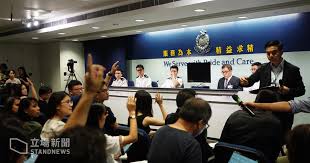
(Picture Source: thestandnews.com)

Journalism and politics have great influence in society. They are mutually connected to and dependent on each other. Due to the recent political situation in Hong Kong, the relationship between politicians, including the police force, and journalists has changed. A lot of press conferences were also held these days for reporting and presenting details of political incidents. Clayman and Heritage (2002) mentioned that the linguistic styles in political interviews have changed and “conversationalized” ,and the social distance between politicians and journalists has been reduced. In order to investigate the situation in Hong Kong, we are going to look into the conversation between the police representatives and some journalists during the Q&A session of the police press conference with regard to the “721 Yuen Long Attack” (See the video below). Several interactional patterns that shape their power relations are found by close conversation analysis of the data.

YouTube link: https://www.youtube.com/watch?v=zwr-1vfRgNY

1. Journalists as “questioners” set the agenda

Journalists took the role of “questioners” and restricted what the police could answer in the next turn at the beginning of the Q&A session. They frame the topics and set the agenda of the following interaction by asking questions based on what the general public would like to know.

2. Police resisted by “asking for permission”The police made use of a strategy of “asking for permission” so as to sustain their turn and power. They are aware of the powerful position of journalists within the interaction. However, the police do not do that to simply admit their less powerful position. Instead, this strategy could smartly turn the police from the less powerful position to a position with advantage. 

Picture source 1: Sing Tao Daily 2: RTHK Live video 20190723 

3. Adjacency pairs allowed journalists to re-negotiate the agenda

Adjacency pairs were seen from the interaction when the police requested permission and journalists granted or rejected the approval. Journalists have a chance to re-negotiate the agenda and the power relationships, especially by rejecting the request.

4. Inserted sequences were used by both sides to sustain themselves as “questioners”

Inserted sequences were found throughout the interaction. Both the police and journalists tried to make use of inserted sequences with an attempt to interrupt the turns and sequences, hoping to turn themselves into the questioner.

5. Police made use of “no details in hand” strategy and silence to avoid answering questions

The police made use of strategies like “no details in hand” and silence to avoid answering questions they refused to talk about. When the police said they could not provide answers since they did not have related details or information in hand, it became challenging for journalists to ask follow-up questions and seek further responses. They seemed to have answered the questions but in fact journalists could not get useful information from their answers. Sometimes, they also kept silent when being asked questions that they might not be able to answer. 

6. Presence of MC maintains the overall power of the police

The assistance and presence of the emcee, who was in charge of leading the press conference and spoke on behalf of the police force, were crucial for maintaining the power of the police force during the press conference. When the emcee said that they should move on to the closing sequence and end the press conference, the police could successfully avoid answering questions since journalists did not have the opportunity to ask questions or enforce explicitness anymore.

To conclude, the communicative style between the police and journalists is indeed “conversationalized”. However, the power relations between politicians and journalists are inevitably still asymmetrical. Despite the fact that journalists could ask questions and set agenda freely at the beginning of the Q&A session, the press conference was held by the police and they had control over the overall agenda. Therefore, they could interrupt and prevent journalists from asking for more details. Their power could be further reinforced by the strategy of “no details in hand” through which they seemed to have answered the questions but journalists could not get any useful information from their answers.